
Contents
- 1 Discover the Excitement: Untold: Adventures Await Game Rules
- 1.1 What’s Included?
- 1.2 Setting Up the Game
- 1.3 Playing the Game
- 1.4 Scene 1: A Risky Situation
- 1.5 Meet Your Characters!
- 1.6 How to Get Involved
- 1.7 Scene 2: The Plot Thickens
- 1.8 Scene 3: An Heroic Undertaking
- 1.9 Scene 4: The Truth Revealed
- 1.10 Scene 5: The Final Showdown
- 1.11 Wrapping Up the Episode
Discover the Excitement: Untold: Adventures Await Game Rules

Welcome to Untold: Adventures Await, the game where you and your friends take on the roles of heroes in an exciting and unpredictable adventure. Just like in your favorite TV shows, Untold is full of unexpected twists and turns that will keep you on the edge of your seat.
Let’s dive right in. The game is divided into five Scenes, each one building on the last to create an epic story. We’ll start by setting the stage for your episode, creating a world filled with danger and excitement.
Once the stage is set, it’s time for the first Scene. This is where the world is faced with a challenging problem, and you and your friends will create characters to solve it. The pressure is on!
As the story progresses, the Plot Thickens, making things even more difficult for your heroes. But don’t worry, because in the next Scene, you’ll have the chance to confront the problem head-on in a Heroic Undertaking.
But that’s not all. In the fourth Scene, the Truth is Revealed, and the stakes are raised even higher. Your heroes are pushed to their limits as they uncover secrets and face unexpected challenges.
Finally, in the last Scene, it’s time for The Final Showdown! This is where everything comes to a head, and your heroes must summon all their courage and wit to overcome the ultimate obstacle and save the day.
Hey there! Welcome to a unique adventure unlike any other. This isn’t your typical game where you focus on winning or losing. No, this is your chance to become a hero, to rise above and conquer the challenges that threaten your world. Are you up for the task? Get ready, because the thrill of epic adventures awaits!
What’s Included?

- Story Board
- Story Cubes Tray
- Set of Rory’s Story Cubes
- Episode Guide Pad
- Character Profile Pad
- 10 Question Tokens
- 14 Action Tokens
- 15 Outcome Cards
- 10x Reaction Cards
- 4 Dashboards
- 4 Play/Pause Cards
- 4 Sets of Edit Tokens
- Rulebook
Setting Up the Game
When you want to tell a story, you need the right tools and materials to help you. That’s where the Rory’s Story Cubes game comes in. It’s a special set that contains everything you need to unlock your imagination and create amazing stories. Let me walk you through the setup and show you exactly what’s included.
First, you’ll find a Story Board in the box. This is where you’re going to build your story, piece by piece. Think of it like a canvas, ready for your artistic storytelling skills. The Story Cubes Tray is another essential component. It’s like a magical container that holds all the Story Cubes. These cubes are the heart and soul of the game, each featuring a unique image that will ignite your storytelling creativity.
When it comes to the Rory’s Story Cubes game, variety is key. That’s why you’ll receive a set of Story Cubes that includes different themes and characters. These cubes serve as prompts for your story, providing you with inspiration and direction. You’ll also get an Episode Guide Pad, which is like your own personal diary for tracking and documenting your story episodes.
To help you develop your characters, there’s a Character Profile Pad. This is where you’ll jot down important details about each character, such as their name, appearance, and personality traits. It’s a handy tool for keeping your characters consistent and well-rounded throughout your story.
As you progress through your storytelling journey, you’ll encounter various situations and challenges. That’s where the Question Tokens come in. Whenever you want to add an element of mystery or suspense to your story, simply draw a Question Token and use it as a prompt to introduce a new twist or turn.
Of course, no story is complete without action. That’s why the game includes Action Tokens. These tokens represent different actions or events that can happen in your story. Use them to inject excitement and movement into your narrative, keeping your audience engaged and eager for the next chapter.
As you make choices and progress through your story, you’ll encounter different outcomes. The Outcome Cards help you keep track of the consequences of your character’s actions. They serve as a reminder of the choices you’ve made and the impact they have on the overall direction of your story.
But storytelling is not just about the characters and their actions. It’s also about their reactions. That’s why the game includes Reaction Cards. These cards allow your characters to respond and interact with the events happening around them, adding depth and realism to your story.
To help you stay organized and on track, you’ll receive four Dashboards. These act as your command center, keeping all your materials and tokens neatly organized and easily accessible. You’ll also get four Play/Pause Cards, which serve as handy reminders when you need to take a break or pause your story.
Editing is an important part of any creative process, and storytelling is no exception. That’s why the game provides you with four Sets of Edit Tokens. These tokens allow you to make changes to your story, whether it’s adjusting the plot or refining the details. Think of them as your editing tools, helping you polish and perfect your story as you go.
Of course, you’ll also find a Rulebook in the box. This guide will walk you through the rules of the game and provide you with helpful tips and suggestions for getting the most out of your storytelling experience.
And that’s it! With this comprehensive set of tools and materials, you have everything you need to embark on a storytelling adventure like no other. So grab your Story Board, gather your Story Cubes, and let your imagination run wild. Are you ready to create your own incredible stories?

Alright, here’s what you need to do:
First, I want you to place the Story Board right in the center of the table. Easy enough, right? Good. Now let’s move on to the next step.
You’re going to need to separate the Scene Cards into different categories: A Dangerous Dilemma, The Plot Thickens, An Heroic Undertaking, The Truth Revealed, and The Final Showdown. Once they’re separated, go ahead and shuffle each set. Take one card from each category and place them face down on the Story Board where it’s indicated. The rest of the Scene Cards can go back in the box; we won’t be using them for the rest of this Episode.
Alright, we’re almost done with the setup. Take the Question and Action Tokens and place them in the marked spaces on the board. Easy peasy.
Now, let’s move on to the Outcome Cards and Reaction Cards. Shuffle each deck separately and place them face down near the board. These cards are important, so make sure you keep the decks separate.
Finally, everyone gets a Dashboard and a set of Edit Tokens. You’ll each get 2 Idea Tokens, 1 Flashback Token, and 1 Modify Token. Make sure you distribute them to all the players.
When we play the game, each of us gets a Play/Pause card and a Character Profile sheet. We also need the Episode Guide sheet and a pen or pencil. In the game, there are nine Story Cubes that we place in the Story Cubes Tray. Now, let’s talk about how to play!
Playing the Game
Choosing the Setting for the Episode
First, we need to decide on the general idea for our setting. We want to come up with something exciting and interesting to start our adventure. To help us, we have four questions in the Episode Guide that we can all discuss and answer together. One person will write down our answers in the spaces provided.
When does this episode take place?
Let’s start by deciding the time period for our episode. We can choose from the Past, Present, Future, or even a time beyond our understanding, known as NonTime. Alternatively, we can specify a specific era, century, or a particular date. We could also set the episode during a significant event, like The Last Days of the Alien Uprising.
Where does our episode take place?
This is the overall backdrop for our episode, a broad setting that allows for the creation of multiple new locations within it. Don’t worry, we don’t have to come up with all the locations right now; that will happen as we play.
For example, if we choose New York City as our backdrop, we can imagine locations like a dark alley, a run-down police station, the Statue of Liberty, and many more.
What do we already know about this setting?
Hey there! So, let’s talk about what we can do in this Episode. Can we have superpowers? Is magic a thing? And what kind of technology are we working with here?
Are we in a high-tech world, or is it more old-fashioned? Is there anything special or different we should know about before we start?
Now, let’s talk about the tone of this episode.
This is a big decision because it sets the mood for our adventure. Do we want it to be dark and intense, or more light-hearted and fun? Should we aim for some laughs, or go for an edge-of-your-seat kind of feeling?
Alright, let’s sum up the setting of our Episode.
Imagine you’re describing this episode to someone who wants to watch the show. Give a quick summary in just one or two sentences. And don’t forget to write the name of our series at the top of the Episode Guide!
Welcome to the exciting world of adventure! It’s time to embrace the thrill of the unknown and embark on a journey that will challenge and inspire you. Adventure holds the power to ignite our senses, awaken our curiosity, and push us beyond our limits. It’s an opportunity to discover new places, meet interesting people, and cultivate unforgettable memories.
As I stand here at the edge of the unknown, I can’t help but feel a surge of anticipation. The possibilities stretch out before me like a vast ocean, inviting me to dive in and explore. I’m ready to take on the unexpected twists and turns that lie ahead, knowing that every challenge is an opportunity for growth.
When you think about it, adventure is really a metaphor for life itself. Just as we navigate through uncharted territories, we encounter obstacles, face our fears, and find the courage within ourselves to overcome them. It’s in these moments of uncertainty that we truly discover who we are and what we’re capable of.
So, my friend, if you’re ready to embark on this incredible journey, there are a few things to keep in mind. First and foremost, embrace the unknown. Allow yourself to let go of control and surrender to the mystery. It’s in these moments of surrender that the magic happens.
Secondly, be open to new experiences. Adventure often presents us with opportunities we never could have imagined. Whether it’s trying a new activity, meeting different people, or exploring a foreign land, say “yes” to these experiences. You never know where they may lead you.
Lastly, trust yourself. Believe in your abilities and know that you have what it takes to navigate the challenges that come your way. Remember, the journey is as much about self-discovery as it is about exploration.
Now, as you embark on your own adventure, I encourage you to take a deep breath, trust in the journey, and let the unknown guide you. Remember, it’s not the destination that matters most, but the moments you experience along the way. So, go forth and embrace the adventure that awaits. Now your adventure can truly begin!

Scene 1: A Risky Situation
Let’s start with a dangerous dilemma. Take a look at the first Scene Card and roll all nine Story Cubes into the Story Cubes Tray. Now, let’s assign a Story Cube to each empty space on the Scene Card and use them to complete the following sentence:
“The story begins at [this Location], where someone or something is being pursued, attacked, accused, or captured by [this Threat].”
Once the Story Cubes are in place, look at the icons on the chosen cubes and combine them with the symbols on the Scene Card to describe what is happening in this Scene. Use the provided sentence as a guide and refer to the Dashboard if you need help understanding the meaning of the symbols.
Scene Cards and Story Cubes
There are five different types of Scene Cards, each with its own sentence structure. Read the sentence format on the card (highlighted in yellow) and fill in the blanks using the icons on the Story Cubes. To understand the icons on the Scene Cards, consult your Dashboard. After everyone understands the Scene, fill in the empty spaces on the card with your own narrative ideas using the Story Cubes.
The face-up icons on the Story Cubes can represent various locations, people, or things in your story. The Setting, Tone, and collective experience of the players may also influence their interpretation. For example, a fire could symbolize a scorching desert, warmth on a cold night, or an enraged enemy. It’s all up to you! Our promise is that when you treat the icons as metaphors open to interpretation, your game of Untold will be more rewarding.

Let me tell you about the dangerous situation our world is facing. Me and my friends, Jun, Amy, and Max, start by flipping the first Scene Card. Jun rolls all nine Story Cubes. We discuss a bit and decide to place the Lightning Bolt icon on the recessed Location space to represent our school’s logo.
Amy has a great idea to use the Bug icon as a Threat. Then Max summarizes the Scene for us. He says, “The Episode begins at the Intergalactic Protectors Academy. K’Chk, who is an insect alien and also the Academy principal, is accusing someone or something, and they are also accusing K’Chk”.

Meet Your Characters!
Okay, so now that we’ve set the stage for our story, it’s time for you to jump in and bring your own character to life. Let’s get started by creating your very own Character Profile.
Remember, we want your characters to fit perfectly into the world you’ve described in the Episode Guide. They should also match the theme of the specific Location and Threat you chose for your first Scene Card.
Creating a Character Profile is a fun process. You’ll roll the remaining Story Cubes for each section and use up to three of them to inspire your answers. However, if you already have a character in mind, you can skip the Story Cubes and go straight to creating them.
Name
Don’t worry about filling in this section first. Sometimes, you come up with a really awesome name after you’ve figured out everything else about your character. But if you think of something really cool right now, make sure to jot it down!
My Job
I work hard every day as a plumber, fixing pipes and solving people’s problems. Whether it’s unclogging a drain or repairing a leak, I tackle every plumbing issue with dedication and expertise.
What Drives Me
What compels me to go on adventures is my unwavering curiosity. I have a burning desire to explore uncharted territories and discover new things. It could be exploring underwater caves or finding hidden treasures in ancient ruins. The thrill of the unknown is what pushes me to take risks and face danger.
Maybe it’s the possibility of encountering new cultures and civilizations or the excitement of solving mysteries that drives me forward. Whatever it may be, my curiosity fuels my adventurous spirit and guides me on my journeys.
Specials
Now it’s time to focus on your character’s Specials. This is where you get to choose something extraordinary about your character. It could be an amazing ability or power, a helpful item or companion, or a special area of expertise or knowledge. At the beginning of your character’s story, you can choose two of these Specials. However, they must be different types. For example, you can choose a power and an item.
Ability / Power
An Ability or Power is a special skill or talent that sets your character apart. It can be something they were born with or something they acquired through training. Your character could have learned skills like marksmanship or cooking, or they could possess superhuman abilities like flight or telekinesis.
Helpful Item / Companion
A Helpful Item or Companion is something or someone that supports your character on their journey. It could be a magical artifact, a powerful weapon, or even a loyal sidekick. This Special provides assistance and enhances your character’s capabilities in unique ways.
So, here’s the deal. On your epic adventure, you’re going to need some things to help you out. But you gotta watch out, because these things can also be very delicate and can easily get lost or stolen. Let’s call them “items.” They could be awesome stuff like a magical sword that gives you special powers, a cool motorbike to zip around town, or even a precious family heirloom that proves you come from a kickass dynasty.
Now, you’re not gonna be alone on this journey. You need a trusty sidekick, “a companion.” Picture this: a loyal butler who puts up with your shenanigans, a clever pet that thinks it’s smarter than you, or a mighty beast that you can summon whenever you need backup in a fight.
Alright, now let’s talk about what you’re really good at. This is your “area of expertise” or your superpower. It’s the thing you’ve studied and practiced long and hard for. Maybe you’re a master in magic, casting amazing spells left and right. Or maybe you’re a survival guru who can thrive in the coldest, harshest places. Either way, you want to choose a superpower that will come in handy when the real action starts.
Each character in the story has a special ability or trait. This special ability can be affected in different ways during an episode. It can be either negative, like when it is lost, broken, or impaired, or positive, like when it is enhanced, strengthened, or enchanted. You can describe the current state of a character’s special ability using a word or phrase that best matches your idea. You also have the option to draw your character’s image in the character profile.
Now that you know who your characters are, take some time to establish the connections between them. Discuss how each character ended up in the same location at the same time. Finally, make sure that everyone knows about each character’s special ability.

Once upon a time, I rolled the Story Cubes and they revealed three symbols that inspired my character. One symbol represented a book, symbolizing that I am a final year student. Another symbol showed a planet, indicating that I have a strong desire for universal justice. The last symbol was a speech bubble, representing my diplomatic nature. Additionally, Amy bestowed upon me the gift of a flying bike.
Let’s talk about the Dashboard now.

The Dashboard is like a cheat sheet that shows all the symbols used in the game. It also keeps track of a player’s changes. These changes can be tokens or cards that let you change or influence the way the Episode unfolds.

Idea Token:
If you have a cool idea to add when another player is answering a question or taking an action, you can use an Idea Token.
When the other player shares their idea, you can use your Idea Token, then add your own part to the story. Just make sure the other player agrees with your addition!

Flashback Token:
To make the backstory more interesting, players can use a Flashback Token to pause the game and tell a story about something that happened before this Episode. This gives more information about characters or places they encountered.

Modify Token:
After rolling the Story Cubes to set a scene or answer a question, you can use a Modify Token to change any one of those Story Cubes to a symbol of your choice.
Be careful though! You can only change the Story Cubes that were just rolled. You can’t change a Story Cube that’s already on the Story Board.

Play/Pause Card:
If you’re not happy with how the story is going, or if you feel like you’re not having fun, you can flip your Play/Pause card to the Pause side.
When you do that, the game stops and you can talk with the group about the problem. Figure out a way to fix it together. Once you come up with a solution that works for everyone, you can start playing again.
How to Get Involved
Now that we have set the stage and created our characters, it’s time to start making things happen in the episode. There are two main ways for us to do this – asking questions and taking action.
We have the freedom to mix and match questions and actions in any order we like. However, it’s important to note that once we take our final action in a scene, that scene comes to an end.
Asking Questions

When I ask questions, I gather information and add detail to the scene. I can ask a number of questions, but I can only ask up to the maximum amount of question tokens for that scene.
When I ask a question, I take one of the remaining question tokens from below the current scene card and place it beside my dashboard so that it is visible to all players. My question must begin with what, where, when, why, who, or how. This allows for multiple possible answers and ensures descriptive responses.
After I ask a question, I roll any story cubes that are not on scene cards. I can then use one, two, or three of the face-up icons on the rolled story cubes to inspire an answer.
I should give memorable names and detailed descriptions to the people, places, and things in my answers whenever I can. This will help bring the story to life for all players.
Hey there! Just a friendly reminder that you don’t have to ask every single question for this scene. Keep it simple!
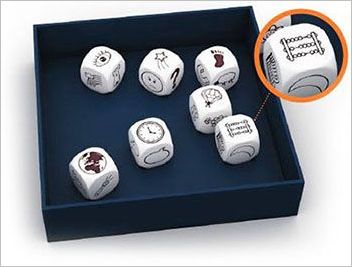
I have a question that’s been on my mind. You know, sometimes it’s hard figuring out which side to take in an argument. Have you ever wondered about that?
Well, let me tell you about this game I came across called Story Cubes. It’s pretty cool. See, there’s this Story Board with these Question Tokens, and you can use them to ask questions.
So, I took a Question Token from the Story Board and asked, “How do we know which side to take in this argument?”
Then, I rolled the Story Cubes, but there was this icon that caught my eye – an Abacus. It got me thinking, and I came up with an answer.
Here’s what I thought: “We instinctively side with K’Chk as they were the first teacher we ever had at the Academy.”
Interesting, right? It’s amazing how different things can inspire us and help us make decisions. Now, let’s talk about taking action.
Taking Actions

When it comes to resolving conflicts in the game, I use Actions. In each Scene, I can take a certain number of Actions, depending on the number of Action Tokens available. To declare an Action, I say one of the following:
“I TRY to __________ by __________.”
“I WANT to __________ by __________.”
I can take Actions in any order I want, but it’s helpful to have a rough plan beforehand.
When I take an Action, I pick one of the remaining Action Tokens and place it next to my Dashboard, where everyone can see it.
It’s important for me to be as specific as possible when describing what I’m trying to do and what outcome I want. This makes it easier for everyone to understand the result of the Outcome Card.
If I want to do something that affects someone else’s character in a game, I have to ask for their permission first. It’s important to respect the other players and make sure they’re okay with it.
Figuring Out What Happens
When I decide to take an action, I flip a card from the outcome deck to see how well I do. There are six possible outcomes, from being really successful to failing miserably.

So, here’s the deal. I’m playing this game called Action Tokens, and I’m totally invested in it. My character, let’s call her Amy, she takes one of those Action Tokens from the Story Board, right? And she’s all like, “I wanna defuse this argument between K’Chk and the High Council by reminding them of K’Chk’s awesome contributions to the Academy.” Pretty cool, huh?
But here’s the twist. She flips over this card from the Outcome deck to see what happens next, and guess what? Disaster strikes! Turns out her carefully planned action is a complete failure. Bummer! Now she has to flip a Reaction card.
But wait, there’s more. Once the Outcome Card is revealed, Amy has to use the result to paint a picture of what went down as a result of her action. Then, yep, you guessed it, the card gets tossed aside.
So Amy, quick on her feet, describes what happened. She starts by telling the High Council about all the amazing things K’Chk has done for the Academy, hoping to sway them. But, oh boy, they’re not having any of it. Their faces are all serious and grumpy, clearly not happy with the interruption. Talk about a mood killer.
Hey there! So, here’s the deal: some Outcome Cards, when played, can really stir things up in a Scene. They make it all dramatic and exciting! And guess what? You can find out which outcomes cause these reactions by checking out the Outcome/Reaction Chart.
The Outcome/Reaction Chart

Unbelievable Success
Wow, would you believe it? Your plan worked out flawlessly and even exceeded your wildest expectations. It’s like a dream come true! You must be feeling on top of the world right now. [Flip a Reaction Card]

Mission Accomplished!
Everything went according to plan. You did it!
Not a single unexpected twist, just smooth sailing all the way. No surprises, none at all. [You didn’t even need a reaction card.]

Success Can Come at a Cost
I achieved my goal, but there’s a catch. Despite the victory, there’s a downside that I didn’t anticipate. It’s a mixed bag of emotions – a combination of happiness and disappointment. [Flip a Reaction Card]

When Things Don’t Go According to Plan, Look for the Silver Lining
Sometimes, things don’t turn out the way we expect them to. We make plans, but life has different ideas. But you know what? That doesn’t mean it’s all bad. In fact, even when things don’t go as planned, there’s often a silver lining waiting for us.
Let’s face it – life can throw us a curveball sometimes. We might not get exactly what we wanted or hoped for, but that doesn’t mean it’s a total loss. Sometimes, when things don’t go according to plan, something positive happens that helps us in some small way.
Think of it as flipping a reaction card. Sure, we may not have gotten what we were originally aiming for, but by embracing the unexpected, we give ourselves the chance to discover something new and exciting. We open ourselves up to opportunities we may not have considered before.
So, when life throws you a curveball and things don’t go as planned, don’t be discouraged. Instead, keep an open mind and look for that silver lining – that unexpected positive outcome that could help you in ways you never imagined.

I couldn’t make it happen
Sorry, but it looks like what I tried to do didn’t work out. [No Reaction Card]

Oh No, Epic Fail!
Your attempt at doing something didn’t go according to plan and, to make matters worse, it resulted in a disaster for the heroes. Instead of achieving your goal, the outcome benefits your enemies or adds an unexpected twist to the situation that they have to deal with. [Flip a Reaction Card]
Understanding Their Response
Reaction Cards show how a character, whether it’s you or someone else in the scene, reacts to the outcome of the action you just took. If a reaction is required, you’ll need to draw a Reaction Card.
You get to decide which character the reaction represents and then describe how that character responds to your action. Once you’ve done that, discard the card and keep playing.

So, there I am, flipping the top card of the Reaction deck. And what do you know? It’s an angry expression staring right back at me. I can practically feel the High Council’s fury radiating off of it. My character’s efforts must have really gotten under their skin because they immediately suspend me from the Academy. Talk about a strong reaction!
But hey, the game goes on. We keep playing, Asking Questions and Taking Actions. And here’s the thing – as soon as we resolve the last Action in a Scene, we’re onto the next Scene Card. It doesn’t matter if we succeeded or failed, or if we still have unanswered Questions. We just keep moving forward.
Oh, and here’s a friendly reminder: you don’t have to use up all your Actions for a Scene. Sometimes, less is more!
Scene 2: The Plot Thickens
Hold on tight because things are about to get interesting! The Plot Thickens is here to shake things up in this episode. To find out what’s in store, all you need to do is turn over the Scene Card. Brace yourself for an unexpected surprise: it could be an Evil Ally, a Terrible Secret, a Dark Agenda, or even an Evil Master.
Now, the key to understanding this twist is to look for the connection between the current plot twist and the previous Scene Card, A Dangerous Dilemma. That link will give you a clue about where this twist is coming from. Maybe it’s connected to the Threat you encountered earlier, or perhaps it has something to do with the Target – you know, the person or thing you’re dealing with. Whatever it is, there’s definitely more going on beneath the surface.
Once you’ve figured out what you’re up against, it’s time to roll the remaining seven Story Cubes. Take a look at the icons facing up on the Story Cubes you rolled, then place one of them on the designated spot on the board. This new cube represents the newest element of the story that the twist has brought into play. To sum it all up, describe the twist in a single simple sentence, combining the symbol on your chosen Story Cube with the icon on the card.
When the plot twist is revealed, it’s my cue to jump back in. Now, I can ask you up to three Questions to dig deeper into the twist and see how it affects the Episode. Here’s the catch: there’s no room for Actions in this Scene. Our heroes are charging straight into a face-off.

When the Plot Thickens, we flip the second Scene Card to find out more. And guess what? It turns out the Target has a Terrible Secret! Exciting, right? Now it’s time to roll the Story Cubes again and see what happens next.
This time, the Footprint icon catches our attention. It sparks my imagination, and I suggest, “What if the High Council knows that the Academy is going to be attacked and destroyed?” It’s a twist that adds an element of danger and suspense. The others love the idea and agree to include it in our story.
Now that we have our plot twist, it’s time for our characters to step up and take action once again. But this time, they can only ask up to three Questions to figure things out.
Scene 3: An Heroic Undertaking
In this Scene, we travel to a new Location to deal with the plot twist we discovered earlier. Here, we might face a new enemy, be challenged by a character, group, or thing that we encountered in the first Scene, or have the newly revealed plot twist pose a direct Threat to us.
No matter what form the Threat takes, it’s there to directly go against your characters’ plans. This creates even more tension as the focus shifts to the heroes themselves!
Turn over the third Scene Card and roll the remaining six Story Cubes. You’ll always use one of the rolled Story Cubes to define a new Location. When it comes to determining the nature of the Threat for this Scene, you have two options. You can either use one of the rolled Story Cubes or reintroduce a Story Cube from a previous Scene.
Bringing Back Story Cubes
From now on in the Episode, you have the chance to bring back previous plot elements (represented by Story Cubes) for added drama.
Regardless of which option you choose to create the Threat, you should be able to describe what’s happening on the Scene Card using one of two sentence formats:
If you want to add an element of suspense and danger to this scene, let me introduce you to the concept of a Terrible Secret or Dark Agenda. Imagine the scene continuing in a new location, where this Terrible Secret or Dark Agenda has now evolved into a Threat that is actively pursuing, attacking, accusing, or capturing us.
But if we’re not going down that route and want to stick with a more straightforward approach, imagine the scene continuing in a new location, where this Threat is now actively pursuing, attacking, accusing, or capturing us.
Alright, now that we’ve set the stage in this new location and established the type of Threat we’re facing, it’s time for us to take action. This time, you’re limited to asking only two questions, but you still have the opportunity to perform up to four actions.
Regardless of whether we triumph over the foe we encounter in this scene or not, the game will move forward to the next Scene Card, titled “The Truth Revealed,” once all actions have been taken.

The game takes an exciting twist as we flip over the third Scene Card. Brace yourself because the story is now moving to a whole new Location, where we find ourselves captured by the Threat.
Here’s how we determine the new Location and the type of Threat. I roll the remaining six Story Cubes and their icons give us some inspiration. The Clock and Star icons catch my eye, and I come up with this thrilling scenario: “The next part of our adventure takes place at the Outtatime Diner (represented by the Clock) where we’re drowning our sorrows in milkshakes. Suddenly, a group of Intergalactic Protectors (represented by the Star) swoops in to arrest us!”
Now it’s our turn to jump into the action! We use our Questions and Actions to try and tackle this unexpected situation head-on.
Scene 4: The Truth Revealed
Here’s what happens in this Scene: You find out the truth about why the Threat from before is doing what they’re doing. This is where things get really intense, because you learn about an even bigger challenge that lies ahead.
To uncover your enemy’s hidden plans, flip over The Truth Revealed Scene Card and roll all the remaining Story Cubes. The Scene Card will show an icon that represents either An Evil Master, A Dark Agenda, Targeting Something, or Targeting A Location.
When it comes to figuring out what secret is revealed in this Scene, you have two choices: you can use one of the Story Cubes you just rolled, or you can bring back a Story Cube from a previous Scene.
Whichever option you go with, you need to be able to describe what’s happening in this Scene using one of these two sentence formats:
If you’re dealing with an evil master or a dark agenda in this scene, here’s what’s been happening: the heroic undertaking has been following the threat the whole time.
But if the threat is targeting this location or something specific, then this is what’s been going on: the heroic undertaking has been targeting the threat all along.
Now, once the truth has been revealed, you have the chance to ask a single question. This question will give you more information about the shocking revelation and how it impacts the episode. But there’s no time for actions in this scene because your heroes are thrown straight into the final showdown.

Hey there! Just a heads up, things are getting really intense in our story. So, remember Amy? Well, turns out she’s discovered a really dark secret. Can you believe it?! Anyway, instead of using the Story Cubes this time, she’s moving that Footprint icon from The Plot Thickens to The Truth Revealed Scene Card.
And guess what? She’s super excited! She comes up to me all like, “OMG, the Intergalactic Protectors have been planning a huge attack on the Academy from the beginning!” Can you believe how crazy this is?
Scene 5: The Final Showdown
Okay, buckle up! We’re going on another adventure together to finally put a stop to all the bad stuff happening. This is like the most important part of the whole story, so it’s gonna be seriously intense! And get this, we’re gonna be facing danger from not just one, but two directions! That’s like double the excitement!
Oh, and here’s a pro tip: make sure we include at least one of the baddies we’ve come across before in this scene. It’s gonna make the ending even more epic, trust me.
So here we are, at the pivotal moment in our story. Flip over that final Scene Card and roll the rest of those Story Cubes. This time, you’ve got two choices when it comes to deciding where this Scene will take place. You can either use one of the Story Cubes you just rolled or bring back the Location Story Cube from the A Dangerous Dilemma Scene. If targeting that particular location was the threat in The Truth Revealed Scene Card, you can even bring back that Story Cube too!
Now, with this being the grand finale, the heroes are up against their toughest challenge yet. They have not one, but two separate Threats to face. And luckily, you’ve got options when it comes to determining the nature of these Threats. For each one, you can either use one of the cubes you rolled, or you can bring back a Story Cube from a previous Scene.
When you play the game, you get to do up to six Actions to face Threats and resolve the whole Episode. No matter what happens with the Threats you encounter in this Scene, the Episode always ends when you take your last Action.
If you’re using the Scene Card where both Threats have captured the heroes, follow this format:
“The Final Showdown takes place at [this Location] where [Threat A] and [Threat B] have joined forces and captured us because [come up with a reason based on the Episode].”
For all other cases, use this format:
I am at a crucial moment in the story. The Final Showdown is about to happen, and it’s happening right here, at this very spot. But let me tell you, danger is coming from all sides.
First, there’s Threat A. They are after us – chasing us with all their might. Why, you ask? Well, it’s because they believe we have something valuable, something they want to take away from us. And they won’t stop until they get it.
But wait, that’s not all. As if Threat A wasn’t enough, now there’s Threat B. They are also on our tail – relentless in their pursuit. You might wonder why they are after us too. The reason is simple- they think we did something wrong, something that has made them angry and vengeful. And they want to make us pay for it.
So here I am, caught between these two threats, feeling the pressure building up. It’s like being in the eye of a storm, with danger closing in from all directions. It’s overwhelming, to say the least.

So, here’s what’s happening: we’ve got this intense game going on, right? The players just flipped The Final Showdown Scene Card, and now they’re finding out about this crazy Location where two big Threats are waiting for them. It’s like a double whammy!
One of the Threats is straight-up attacking them, while the other one is all like, “Hey, you guys did something wrong!” It’s a total mess.
Anyway, this guy named Jun rolls these Story Cubes, and using this cool Pyramid icon, he suggests that the grand finale should go down at the Headquarters of the Intergalactic Protectors. And then this other person, Max, comes up with the idea of bringing back the Intergalactic Protectors as the ones attacking in this Scene, by moving this Star icon from somewhere else. It’s getting wild!
But wait, there’s more. This person named Amy puts this Book icon on this little space that’s left. And then she gives a quick summary of what’s happening – the Final Showdown is all going down at the Headquarters of the Intergalactic Protectors, and these guys are freaking out because they think we’re about to expose their evil plan.
But that’s not all! At the same time, the High Council is accusing us of lying! They’re saying we’re just trying to get back at the Intergalactic Protectors because they kicked out this person named Natascha from the Academy. It’s like a big, messy tangle of accusations!
So now, it’s up to our heroes to face these Threats head-on. They’ve got their final Actions to make everything right. Can they prove their innocence to the High Council and save the day? Or will the corrupt Intergalactic Protectors stop them in their tracks?
Wrapping Up the Episode
No matter how the episode unfolded, you’ve left an indelible mark on this world. Once you’ve completed The Final Showdown, make sure to fill out the After Episode sections in the Episode Guide.
If you haven’t done so already, jot down the important people, places, and things you came across in this episode. Then, answer the two questions provided in the Episode Guide.
“How does this episode impact the overall series?”
Your choices and the actions of the characters you encountered have undoubtedly influenced the world. Take note of how the setting has transformed as a result of your efforts.
“What loose ends and storylines should be explored in future episodes?”
Every adventure has loose ends that can lead to new stories. Take note of any unfinished storylines for future inspiration.
And now, for a way to document your character’s personal journey and development, you should fill out the Character Highlights for this episode on the back of your Character Profile.
We want you to have an incredible time playing Untold: Adventures Await, and we can’t wait to hear about the amazing moments you create. Everything you need to imagine exciting tales and thrilling adventures, full of surprises, is now in your hands. And it all starts with a roll of your Story Cubes!
If you decide to play multiple Episodes of Untold in the same Setting, those Episodes become part of a Series. I’ll walk you through the small changes you’ll need to keep in mind starting from Episode 2. Visit thecreativityhub.com/untold for more information on playing a Series and to get a useful Series Guide.
Setting Up
You’ll need to have your Character Profiles and Episode Guides from the previous Episode(s) ready. While you can reuse your Character Profiles, the previous Episode Guide(s) are only there as a reference for your new Episode.
The status of any Specials remains the same across Episodes. For example, lost items remain lost.
Choosing Your Setting:
Hey there! So, let’s talk about creating a new Setting or going back to one from a previous Episode. If you decide to revisit a previous Setting, you can check your Episode Guide(s) for all the details on how things might have changed in that Setting.
Scene 1: A Dangerous Dilemma
Now, when it comes to choosing the Location and the Threat for this Scene, you have two options. You can use one of the rolled Story Cubes, or you can bring back a Location or Threat from a previous Episode. It’s all up to you!
If you want to bring back something from a previous Episode, just spend a Modify Token to change any Story Cube to the icon you want. It’s a neat little trick that you can only do after you’ve rolled the Story Cubes to set up the first Scene.
Scene 2 To Scene 5:
Ending The Episode:
When I fill out the Character Highlights section on the back of my Character Profile for this latest Episode, I get to add two new Specials if this is the end of my second or fourth appearances. It’s always exciting to see my character grow and develop!
But you know what’s even more thrilling? If this is my seventh appearance in the Series, I become an Iconic Character. That means I take on an Iconic Role, chosen by the creator of the show. I become a leader or a legendary figure in the Setting, and that’s pretty amazing.
The best part is, if I come back to the Series again, my former character can make guest appearances and be a part of the story in future Episodes. It’s like being a celebrity in the show!