
Contents
- 1 Welcome to the Game of Liar’s Dice!
Welcome to the Game of Liar’s Dice!
Have you ever played the game of Liar’s Dice? If not, let me introduce you to the exciting world of this classic dice game.
The rules of Liar’s Dice are quite simple. All you need is a set of dice and a group of friends ready to have some fun! The objective of the game is to guess how many of a certain number you believe are hidden under everyone’s cups, without revealing your own dice. Sounds easy, right?
Here’s how it works:
- Each player starts with a cup that contains five dice.
- Everyone rolls their dice secretly and looks at what they have.
- Starting with the first player, each person takes turns guessing how many dice of a certain number are on the table, including their own.
- Each subsequent player must either challenge the previous bid or raise the amount of dice they believe are on the table.
- If a challenge is made, all cups are revealed, and the bid is either confirmed or proven wrong.
- The loser of the challenge loses one of their dice, and the game continues until only one player has dice remaining.
This game is all about bluffing and trying to read the other players. You never want to reveal your true dice numbers, but you also need to pay attention to how many of each number are being bid on. It’s a delicate balance of strategy and luck!
Liar’s Dice is a game that anyone can enjoy. It’s perfect for parties, game nights, or even just a casual get-together with friends. So grab your dice, gather your pals, and get ready for a thrilling and unpredictable game of Liar’s Dice!

When you play a game, you go through different rounds. In each round, you and the other players roll your dice. Then, you make a bid to start the game, and the bidding continues until someone challenges it. If a challenge happens, it needs to be resolved.
If someone makes a wrong challenge, they lose dice. If a player loses all their dice, they’re out of the game!
Getting Ready
The Red Die
Put the red die on the bidding track to show your bid.

The Exciting World of Bidding
When bids are made and increased, the red die on the bidding track moves in a clockwise direction. It’s fascinating to see how the stakes change with each bid!
Choose Your Bidding Space
Here’s where things get interesting! You have two options: Number Bid Spaces or Wild Bid Spaces. This decision impacts all players as they must decide whether to compete or pass. The tension builds as everyone weighs their options.
The Mysterious Lost Dice Squares
If you lose a round and your dice are out of the game, they find their place on the Lost Dice Squares. It’s like they disappear into an enigmatic void, waiting for the next game.
Unveiling the White Dice
Get ready for some intense competition! All players, including yourself, have the opportunity to bid on the white dice currently in play. The thrill of anticipation runs high as everyone vies for the chance to win.
Time to Play
1. Roll the Dice
Now, let’s get this game started! Grab your dice cup and five white dice. Shake them up and give them a roll, but don’t let your opponents take a peek. Keep your roll secret by covering them under your cup.
Feel free to sneak a glance at your cup as much as you want, but remember, keeping things secretive is key in Liar’s Dice! First, we need to choose a player who will kick off the bidding for the first round. (For subsequent rounds, the winner of the previous challenge gets the honor of starting off).
Okay, let’s start with a bid. You can announce any number or wild star as your opening bid, regardless of what you actually rolled. There are two types of bids: Number Bids and Wild Star Bids.
Number Bids are made on the non-starred spaces along the bidding track. When you make a Number Bid, you’re basically saying that if all the dice on the table (including yours and your opponents’) were revealed, a specific number or wild star would show up.
Hey there! Let’s talk about a fun game called “Wild Stars.” In this game, I and three other players have a bunch of dice. The idea is to guess how many dice with a certain number are in play. It might sound confusing, but don’t worry, I’ll explain it all!
So, here’s the deal: all the matching numbers and Wild Stars on the white dice count towards a number bid. For example, let’s say I have two fives and my opponents each have one Wild Star, but no fives. In total, that would be five fives in play (2+2+H+H+H).
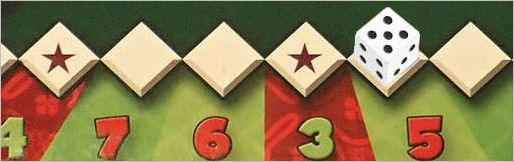
Now, after carefully observing my opponents and looking for any weaknesses in their eyes, it’s time for me to make my number bid. I do this by placing the red die on a number space, just like in the picture below.
By putting the red die on a certain number, I’m declaring that there are at least that many dice with that number in play. For example, if I place the red die on the number five, it means I’m saying that there are at least five fives in play.
So, that’s how the bidding works in Wild Stars! It’s all about guessing and strategizing based on the dice you have and what you think your opponents might have. Have fun playing!
Welcome to Wild Star Bids!
Imagine this: you make a claim, and if all the dice on the table are revealed, they will show a specific amount of Wild Stars. And the best part? Only Wild Stars count towards your bid. It’s like a mind game where you can trick your opponents into getting rid of their dice.
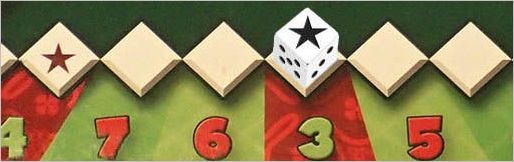
Before making your move, observe your opponents closely for any signs of patterns. Once you’ve spotted an opportunity, it’s time to make your Wild Star Bid. Just place the red die on a space with a star, like in the illustration below. Easy, right?
So, what does your bid mean? Well, in this case, you’re claiming that there are at least three Wild Stars in play. How’s that for a strategic move?
3. Bluff, Bluster, and Raise
Once the first bid is placed, the game continues to the left. At this point, you have two choices:
- You can raise the current bid
- You can challenge the current bid
Keep in mind that when you raise a bid, you need to take into account all the white dice in play. This includes your own dice, as well as the dice held by your opponents, even if you can’t see them.
This game is all about bluffing and creating an illusion of confidence. It’s not only allowed but also recommended to deceive your opponents by placing a bid they can’t resist.
Remember, there is no option to pass your turn in this game. So don’t let your opponents see the nervousness on your face. You must either raise the bid or challenge it when it’s your turn!
When it comes to playing Liar’s Dice, raising the bid is where the strategy comes into play. Depending on your opponent’s bid and the dice you have, there are a few different ways you can raise the bid. And let me tell you, bluffing your opponents is not only fun, but it’s also a strategic move!
Here are two ways you can raise the bid:
- First, you can keep the red die on the same bidding space and show a higher number on the die. Let’s say your opponent’s bid was four 3’s. Well, you can easily top that with a bolder bid of four 4’s, four 5’s, or even four 6’s!
- Alternatively, you can move the red die clockwise to any higher Number Bid space and show any number on top. So, if your opponent declares a bid of four 3’s, you can really rattle their confidence by confidently bidding five 2’s, six 5’s, or even seven 3’s!
Or, you can shift the red die clockwise to any Wild Star Bid space and display the Wild Star on top. (For example, if your opponent declares a bid of four 3’s, you can counter their boldness with a bid of 3 Wild Stars, since it is in a higher position (clockwise) from the previously announced bid).
Note: Right after opening or increasing the bid, you have the opportunity to utilize the Show and Reroll Rule. This rule will be explained later on.
Challenging the bid
If you don’t believe there are enough white dice in play to support the current bid, then instead of raising the bid, you can challenge it. You are only allowed to challenge a bid on your turn, and you must call out, “Challenge” or “Call” to prompt everyone to reveal their dice.
4. Resolving the Challenge and Ending the Round
So, here’s how it all works: Once you decide to challenge someone’s bid, I lift my cup along with everyone else, and we all reveal our dice. The next step is counting. We count all the dice that match the bid. It’s pretty straightforward; if it’s a bid based on numbers and Wild Stars, we count both. If it’s a Wild Star bid, we only count the Wild Stars.
Now, let’s talk about what happens next. We need to determine whose dice bite the dust.
- If the actual number of dice is more than the bid amount, you lose the challenge. Oops!
- If the actual number of dice is less than the bid amount, well, you guessed it – the bidder loses the challenge.
- But wait, there’s more! If the actual number of dice is exactly the same as the bid amount, everyone except the bidder loses the challenge. That’s what we call a “Perfect Bid.”
Losing Dice: When you lose a challenge, you’ll lose the number of dice you bid minus the number of dice actually on the board. If you bid the exact number, all players except the bidder will lose one die. Check out the Challenge Examples below for a better understanding.
Let’s take a moment to mourn our lost dice as we place them in the Lost Dice Squares at the center of the gameboard. These dice won’t be in play for the rest of the game. Once you’re out of dice, you’re out of the game!
Challenge Examples
Example 1: Let’s say you challenge a bid of nine 5’s. After revealing the white dice, you count seven 5’s and four Wild Stars.
There’s a total of eleven 5’s – two more than the bid.
“Can you believe it? The bidder was absolutely right! There were actually nine 5’s in play. That means I lose the challenge and have to give up two of my white dice. I can’t help but feel a little downcast as I watch them disappear into the Lost Dice Squares, never to be seen again… or at least until our next game.”
Here’s another example:
Imagine this: I challenge a bid of six Wild Stars, feeling pretty confident in my decision. But when the dice are revealed, there are only five Wild Stars. I was wrong, and as a consequence, I have to surrender one die. It’s a bit of a bummer, but hey, gloating is always welcome in this situation!
Example 3: Imagine this situation: you’re playing a game called “A Perfect Bid.” Someone makes a bid of fourteen 2’s. The dice are uncovered, and to everyone’s amazement, there are exactly fourteen two’s and Wild Stars! What a stroke of luck! Now, here’s the fun part – all the players, except the one who made the bid, have to give up one die to a Lost Dice Square. It’s like a little sacrifice to celebrate your victory. You could even go for a group hug if you’re feeling really festive! (By the way, check out The “Die Hard” rule to see what happens when players are left with only one die).
Starting a New Round
So, once the challenge has been sorted out, you gather up the dice that are still in your possession and put them into your trusty dice cup. Give them a good shake, and then it’s time to roll again. The player who won the last challenge gets the red die and kicks off the bidding for the new round. You can start bidding from any position on the bidding track. Let the games begin!
The Show and Reroll Rule
Hey there, if you’re someone who likes to mess with your opponents’ heads, I’ve got a rule that will make bluffing and bidding even more fun!
Right after you open or raise a bid, you can take some of your dice and place them outside of your cup for everyone to see. Then, you can reroll and hide all the remaining dice. If any of the rerolled dice match your bid, they will still count towards it. Cool, right? This strategy of showing and rerolling might just increase your chances of winning a challenge.
You can show as many dice as you want outside of your cup, as long as you have at least one die left to reroll. The dice you show don’t have to match your bid exactly. They will stay visible to everyone, outside the cup, for the rest of the round. If they match the bid, they will be counted towards it. So, showing and rerolling might just save your bacon and help you keep your dice!
Show and Reroll Example: Let’s say I’m playing a game where the goal is to roll as many 6’s as possible. At one point, I have four dice left: one 6, one Wild Star, and two 4’s. The current bid is ten 6’s, but I think I can do even better. So, I raise the bid to eleven 6’s. Now comes the exciting part. I reveal my 6 and my Wild Star, showing my opponents that I have at least two 6’s in my hand. But I still have those two pesky 4’s. So, I decide to reroll them.
If someone challenges my bid, I don’t have to worry. The 6 and Wild Star that I showed, as well as any additional 6’s or Wild Stars I may have gotten from the reroll, all count towards my bid. So, even if I didn’t roll any more 6’s, I’m still in the game.
The Ultimate Rule of the Last Die in “Die Hard”
Hey there, my fellow dice enthusiasts! I’ve got an important rule to share with you, and it’s called the “Final Die/Die Hard” rule. Brace yourself, because it’s going to blow your mind!
Picture this: you’re down to your last die, hanging on for dear life. Meanwhile, there’s a perfect bid on the table, but you’re not the one challenging it. Got that scenario? Good, because here’s where it gets interesting.
In this nail-biting moment, if you’re not the player throwing down the challenge, you get a miraculous lifeline. That’s right, my friend. You cannot lose your final die! Let me give you an example to make things crystal clear.
Imagine you’re playing with Shane, Mike, and Mary. You’ve only got one dice left, while Shane has four, and both Mike and Mary have three each. Suddenly, Mary makes a bold bid, claiming there are eight 5’s on the table.
Now, hold it right there. If you were to call Mary out on her bid, then all players (except Mary) would have to sacrifice one die each. However, if you stay silent and let Shane take on the challenge, something remarkable happens. You, my friend, are protected by the “Final Die/Die Hard” rule!
So, even if Mary’s bid turns out to be spot on and there are indeed eight 5’s, you don’t lose your die. You get to keep that final survivor! It’s like having your own action-packed movie moment, right at the table.
The Thrilling Conclusion of the Game
Are you ready for the grand finale? Keep playing rounds, my friend, until there’s only one valiant player left with one or more dice in play. And when that happens, it’s time to break out the dance moves and unleash the celebration! Yes, my friend, that player is the ultimate winner!