
Contents
STRUGGLE FOR CATAN
WELCOME TO STRUGGLE FOR CATAN
Welcome, fellow players, to the fascinating world of Struggle for Catan! This incredible game is all about managing resources and making strategic moves. Get ready to embark on an exciting journey that will test your skills, wit, and determination!
In this game, you won’t find a traditional game board or rolling dice. Instead, you’ll experience the true essence of Catan through cards. Players will engage in resource trading, construct settlements, roads, and cities, and strive to earn victory points. The player who manages to accumulate 10 or more victory points first will emerge victorious!
WHAT’S INSIDE THE BOX
Hey there! Let’s talk about the game components for a moment. It’s always important to understand what you’re working with, right? So, in this game, you’ll come across some interesting cards. We’ve got a total of 67 Resource Cards, which include 11 Brick, 11 Lumber, 15 Wool, 14 Grain, and 16 Ore. These resource cards are super valuable because they’re used for constructing various things in the game, like roads, settlements, cities, city expansions, and knights.
Now, when it comes to representing these constructions, we’ve got 42 Building Cards. These are the real deal! They include 9 Road cards, 15 Settlement/City cards, 5 Knight cards, and 9 City Expansion cards. Each of these cards plays a vital role in building up your little empire in the game.
Let’s get set up!
Alright, let me explain the setup process to you. The number of cards you’ll be using depends on how many players are in the game. Now, here’s the trick: you’ll notice a player count indicator on the Building Cards. For a game with just 2 players, you need to remove all the cards that have a three or four player count indicator. If you’re playing with 3 people, those cards with a four player count indicator need to be removed. And finally, for a full-blown 4 player game, hold on tight because you’re gonna use all of the Building Cards. Phew, quite a setup, right?
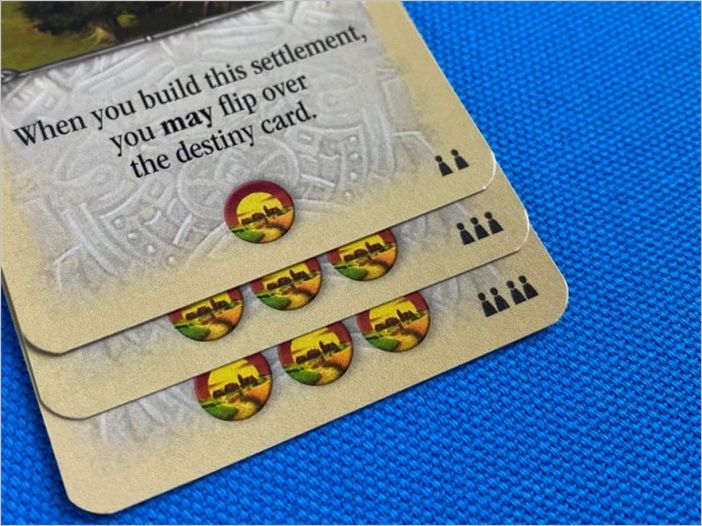
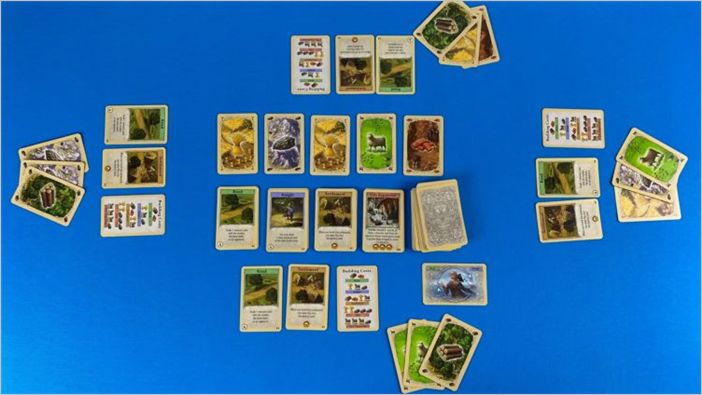
So here’s what we’re gonna do: we take all these Building Cards—roads, settlements/cities, knights, and expansions—and put them in the middle of the playing area, making sure the settlement side is face-up and the knight cards are on their A-side. Oh, and stack those city expansion cards face-up too!
Next, we shuffle up those resource cards and create a draw pile, placing them facedown. From that pile, grab five cards and lay them face-up in a row. This row is the market. And just to keep things interesting, each player gets a secret hand of three resource cards.
But wait, there’s more! Each player also gets a card that tells them how much it costs to build stuff—settlements, roads, and buildings. The road card stays on the table with the A-side up, and the settlement card does too. Oh, and guess what? Everyone starts the game with one victory point in the bag. Nice!
If you’re playing a game with three or four players, just put the Destiny Card next to where you’ll be putting all the cards that have been discarded. But wait! This card doesn’t get used if you’re playing with just two players.
The Game Begins
Alright, it’s time to kick things off! Remember, the oldest player gets the honor of going first. Now, let’s take a look at what you can do on your turn. You’ve got three actions at your disposal: trading, building, and drawing. And hey, just so you know, there’s a specific order you need to follow when performing these actions.
Trading: Connecting and Exchanging
Trading is a pretty important part of the game. Here’s how it works. You have the option to trade one or more of your resource cards. There are a few places you can make these trades: with the draw pile, with the market, or even with one of your fellow players. But here’s the catch – how many cards you can trade depends on the number of roads you’ve built with the A-side facing up.
If you haven’t flipped any of your roads to the A-side, you can only trade one card. And by the way, your trade partner in this case would be the draw pile. But let’s say you’ve managed to build some roads with the A-side face up. Well, now you have the opportunity to up your trade game!
For every road with the A-side up, you gain the ability to trade an additional resource card. So, if you’ve got three roads with the A-side showing, you can trade 0, 1, 2, or even 3 cards when it’s your turn to trade. It’s all up to you!
Trading with the draw pile works like this: First, you pick a few cards from your hand and put them in the discard pile. After that, you take the same number of cards from the draw pile.
If you want to trade with the market, you simply choose the cards you like and replace them with an equal number of cards from your hand.
To trade with another player, here’s what you do: They hold out their hand of cards, face down. You take the cards you want and add them to your hand. Then, you give back the same number of cards to the player. You can even return the same cards you took.
I don’t have to make all my trades using the same option. Let’s say I want to trade 3 cards. I can trade with the market, the draw pile, or my opponent. I can mix and match as long as I don’t go over my trade limit for the turn. My trade limit is equal to the number of road cards with the A-side face up.
BUILD
I place a building card face up on the table and pay the resource cost to the discard pile. If I have three of the same type of resource, I can use them instead of the required resource on the card. I can do this as often as I want when playing a building card. However, I can only build one of each type of building on my turn.
So, here’s the deal when it comes to placing roads on the game board. You want to make sure they are positioned in a way that allows you to see the text and victory points. To do this, just overlap the columns a bit. It’s important to note that the first road card you play should have the A-side facing up. Then, the next road card should have the B-side facing up. Keep alternating in this pattern as you play more road cards.
Now, let’s talk about knight cards. They follow the same placement rules as roads. So, you’ll want to overlap the columns again. Eventually, all of your road and knight cards will be played. But don’t worry! Even after that happens, you can still pay to build more of these things. And here’s a cool twist – when you pay to build, you get to steal a road or knight card from one of your opponents. How awesome is that?
Here’s how it works: once you pay the resource cost to build, you take the topmost road or knight card from your opponent’s column. Pretty sneaky, huh? But wait, there’s a catch! If you have a Church, the first knight card in your column is protected. No one can steal it. And if you have a Castle, the first three road cards in your column are off-limits to thieving hands. So, make sure you strategize and use these cards wisely!
Okay, here’s the deal. You can keep building settlements until there are no more settlement cards left. And hey, when you build a settlement, you have the option to flip the destiny card if you feel like it. Now, once you have a settlement, you can take it to the next level and turn it into a city. All you gotta do is pay the city resource cost and flip that settlement card over. Oh, and once you do that, something cool will happen. There’s an event on the card that you should read out loud to everyone.
If you want to spice things up even more, you can buy city expansion cards. These babies go on top of your city card and you can only have one of each type.
Time to Draw
When you’re done building, you can treat yourself to some resource cards. You get to draw two from the pile. And if you’ve got knights with the A-side showing, you get to draw even more. One additional card for each knight, to be exact.
Scoring
As you play the game, you earn victory points based on the cards you’ve played. Keep that in mind!