
Contents
RACQUETBALL
Racquetball, a racket sport similar to squash, paddleball, and tennis, was created in the 1950s by Joseph Sobek. A skilled player in squash and tennis, Sobek wanted to enhance the sport and set out to find ways to do so. He reached out to manufacturing companies and received multiple samples of balls and rackets for experimentation.
After careful consideration, Sobek settled on a larger racket and a more lively ball, which would increase the speed of racquetball compared to squash. His modifications transformed the sport, giving birth to a fast-paced and exciting game.
Let me tell you about some fascinating changes that happened at the YMCA. They made a few adjustments that got people excited, especially when it came to playing sports. One of the most popular changes was switching out the handball courts for racquetball courts. It turned out that a lot of people wanted to play racquetball instead of handball, so the YMCA listened to their members and made the switch.
Now, you might be wondering why the YMCA didn’t promote racquetball right away. Well, they were a bit hesitant and unsure about it. But even though they didn’t actively promote it, racquetball started gaining popularity in nearby cities and states. And before they knew it, the sport had spread all around the world!
SETUP
EQUIPMENT
The Ball: A racquetball is a rubber ball that’s 2.25 inches in diameter and weighs 1.4 ounces. When you drop it from a height of 100 inches, it should bounce between 68 and 72 inches high. It’s super bouncy!
The Racquet: Racquet frames can be made of any material, as long as they don’t exceed 22 inches in length. It’s also important to attach the racket to your wrist with a wrist cord for the safety of everyone playing.
Eye Protection: While it’s not required, I highly recommend wearing eye goggles in competitive racquetball matches because of how fast the ball moves.
COURT
Did you know that a racquetball court is 20 feet wide and 40 feet long? It’s surrounded by four walls – the front, back, and two sides – which you can use to your advantage during a game. The service line is 15 feet away from the front wall, and behind that is the short line, another 5 feet back. The area between these two lines is called the service box. Finally, there’s a dotted line 5 feet behind the short line, which is the receiving line.
Let’s Play!
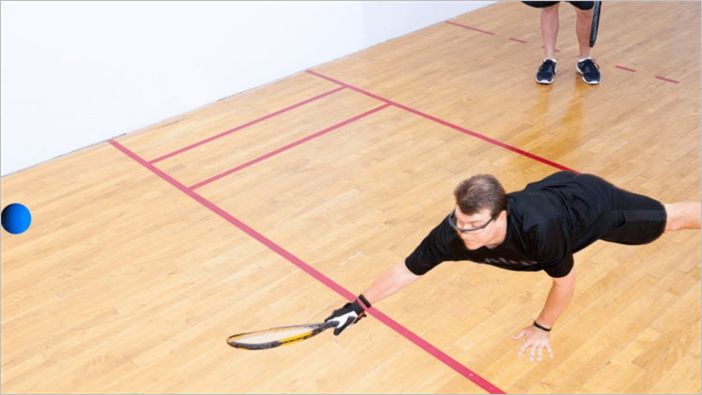
When you start a game of racquetball, you serve the ball towards the front wall. To make a successful serve, the ball needs to hit the front wall without touching the ground twice. After the serve, it’s the other player’s turn to return the ball before it hits the ground twice.
You can hit the ball against as many walls as you want, as long as it doesn’t touch the ground twice. This means you can hit the ball multiple times if needed, as long as it doesn’t bounce on the floor twice.
SCORING
Like squash, in racquetball, I don’t score points, I win serves. This means that only the person serving the ball can actually earn a point. I win a serve when my opponent can’t legally hit the ball back to the front wall before it bounces twice. The person receiving the serve can’t score a point by winning a rally, but they do get the next serve and they don’t lose a point by doing so.
Racquetball games are usually played as a best-of-three series. This means that within each “match,” there are two or three individual “games.” To win a game, you have to be the first person to reach 15 points. However, in the tiebreaker game (game three), the target number drops to 11 points.
DOUBLES
Racquetball is a game that can be played with either two players, known as singles, or four players, known as doubles. Even though there are more players in doubles, the basic rules remain the same, with only slight changes to how the serve is done. In doubles, the teammates decide who serves first and take turns serving.
Serving and Receiving Rules
- When you serve in racquetball, you have to let the ball bounce once on the ground before hitting it toward the front wall.
- The serve must hit the front wall first and then rebound beyond the designated “short line” to be considered a proper serve.
- The receiving player must stand behind the “receiving line” while waiting for the serve.
When playing racquetball, it’s crucial to remember that you should move out of the way after serving or receiving the ball. If you stay in the ball’s path and obstruct your opponent’s view or ability to hit the ball, it’s called a “hinder” and the serve is replayed, except when a possible point was taken away.
If you want to see an amazing rally, check out the video below! It’s a game-changing rally that will leave you in awe.
When it comes to the end of the game, the player or team who reaches the target score in two out of three games is declared the winner of the match. Good luck and enjoy the game!
I’m a writer who absolutely loves getting people excited about playing games and having a blast. For 3 whole years, I organized pub crawls where we played drinking games just about every day with all the folks who joined us. And, it’s not just a coincidence — I come from a family that’s absolutely obsessed with games, so you could say it runs in my blood.
Now, if there’s one thing I’m crazy about, it’s traveling and music. In fact, I’ve even started my own little blogs where I share all my adventures and discoveries in the world of travel and music.