
Contents
Welcome to the Trapwords Game!
Are you ready for an incredibly fun and challenging word game?
The Trapwords Game is all about guessing and avoiding traps while trying to communicate with your team to find the correct word. It’s a game that will put your communication skills to the test and keep you on your toes!
Here’s how it works:
- First, divide yourselves into two teams.
- Each team will choose a person, called the “Trapper,” who will be in charge of setting the traps.
- Now, let’s decide on the Secret Word. It can be any word in the English language, like “dog” or “car.”
- Both Trappers write down secret trapwords related to the Secret Word. These trapwords are words that they think their teammates might accidentally say while trying to guess the Secret Word.
- The teams take turns. One team selects a guesser, who will try to guess the Secret Word.
- But here’s the catch! The Trapper from the other team secretly chooses some trapwords and sets them as traps. These trapwords are the words the guesser should try to avoid saying.
- The guesser starts guessing, while their team listens closely. If the guesser says a trapword, they set off a trap, and their turn is over. The other team now has a chance to guess.
- The first team to correctly guess the Secret Word wins the round!
The Trapwords Game is both exciting and challenging. It tests your ability to think on your feet, communicate effectively, and avoid the hidden traps. It’s a game that guarantees laughter and high-energy competition.
So gather your friends and get ready for a wild and word-filled adventure!

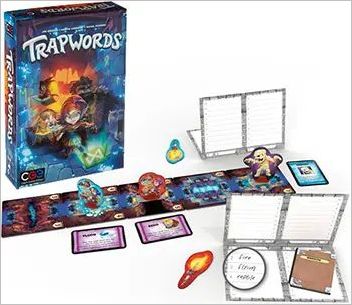
- 2 team figures
- 7 room tiles
- 5 monsters
- 3 plastic stands
- 10 curse cards
- 50 word cards
- 10 monster cards
- 4 books
- sandtimer
- 2 pencils
- 2 torches
- pad of trapword list sheets
Getting Ready
Trapwords is a fun game that involves teamwork. You will need to divide into two teams and sit across from each other at the table. Each team should have at least two players. If you have an odd number of players, it’s okay if one team has more players than the other.
Take the two team figures and put them in the plastic stands. Place them in room 3 on the game board. Your team’s figure is the one closer to you.
Arrange the 7 room tiles in order. One team will see them from left to right, while the other team will see them from right to left. We recommend using rooms 3, 4, 5, 6, and 7.
Hey there! Let’s get this game started, shall we? Grab the torch that matches your team’s figure and put it in front of the first player who will be giving clues for your team. If you’re not picky about who starts, both teams can give their torches to the players sitting on the ends.
We need to add some mystery to this game, so let’s shuffle the curse cards and randomly choose two. These curses are a secret, so keep them face down. Put one curse beside the second room and the other beside the room right before the monster.
We’ve got some wicked monsters waiting for you! There are two decks of monster cards. You can go with the ones without asterisks, unless you’re feeling extra brave and want to spice things up with nastier monsters. Shuffle the deck and pick a random monster.
Now, find the cardboard figure that matches the chosen monster. Put the figure in a stand and place the monster in the final room, which is the room with the highest number. Fold the paper to keep your trapwords hidden from the other team.

Alternative Setups
Once you’ve become familiar with the game, you can try out different curses and rooms. For example, you can experiment with rooms 2, 4, 6, 8, and 10, while placing the curses in the first four rooms. The game allows for easy customization and flexibility.
Choose a Word Set
On the table, place the deck of word cards. You can shuffle them if you’d like, but be careful not to peek at the words – we don’t want to spoil the surprise!
Trapwords offers two sets of words, each written on both sides of the cards. To choose your set, simply select a book:

You might be wondering, which books should you choose? Well, here’s the thing: it doesn’t really matter. Both lists have plenty of “regular” words, so you can’t really go wrong. But there is a slight difference between the two. The fantasy list includes some words that might seem normal in a fantasy world but not so much in the real world. On the other hand, the other list has a few words that wouldn’t quite fit into a medieval fantasy setting.
Now, let’s talk about the rules of the game. Both teams should have the same type of book, so make sure you only use the books from your own team’s list. The other pair of books is off-limits for this particular game.
Trap List
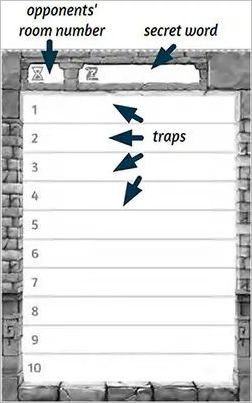
Hey there! Let me tell you about this awesome game I found called Trapwords. It’s super fun and easy to play!
In each round, both teams have to come up with a list of trapwords. It’s like a game within a game! And to make it easier, you get a tablet of trapwords sheets that you can use for the whole game. Cool, right?
Now, here’s the twist – after 4 rounds, you’ll have to flip the sheet over and continue playing on the back. It’s a sneaky surprise to keep things interesting!
Don’t worry, the game won’t drag on forever. It’s designed to be completed within 8 rounds. So you can have a blast playing without it taking up your whole day.

How to Play the Game
Playing the game involves two main parts:
- First, both teams need to come up with lists of words to trick the other team.
- Then, each team takes turns guessing their secret word, while trying to avoid falling into the traps set by the opposing team.
If you want a quick overview of how to play, check out the Overview leaflet.
Creating Traps
Start by picking a word card from the deck. Keep in mind that the other team might have seen the words on the face-up side, so place the card in your book with the reverse side facing up. Close the book. Without you knowing it, your book has magically selected one of the eight words on that side of the card. This is the secret word that the other team has to try and guess.
Imagine this: you’re playing a game where you have to guess a secret word. The person giving you clues about the word might say certain words that could trick you into guessing the wrong thing. But here’s the twist – you know who’s giving you the clues, so you can try to outsmart them.
Now, there are some rules to keep things fair. You can only write down trapwords that are related to the secret word. So, no generic words like “is” or “it” that could be used for any word. The goal is to come up with tricky trapwords that might lead your opponents astray.
This is how it works: your team writes down their trapwords on a piece of paper. Then, you pass the paper around, giving everyone a chance to contribute their trapwords. It’s a bit like a brainstorming session, but with a mischievous twist.
When playing the game, it’s essential to have the same number of trapwords in your list as the number printed on the other team’s room. For example, if the other team is in room 3, you will need to come up with 3 trapwords. Once everyone has suggested their trapwords, you may end up with more than you need. In that case, your team must work together to decide which ones to remove from the list.
Remember, the trapwords should be chosen by the entire team, not just one person. Let the other team know when you have completed your list.
Determining the Order of Play
After both teams have created their trapword lists, it’s time to exchange books and start giving clues. During this part of the game, teams will take turns. If one team is behind, that team will be the first to give clues.
When we start the game, none of the teams are behind, so you and I need to check our books. Both of our books look the same, except for one small difference: one of them has a glowing symbol. If neither of us is behind, the book with the glowing symbol is the one that gets passed around first. And that means it’s your team that will give the clues first.

Giving Clues
So, let’s imagine you’re the one who’s in charge of giving clues to your team. The other team has handed you the book and it’s up to you to pick it up and take a look at the secret word.
After you’ve had a chance to read the word, the other team will start the timer. From that point on, your mission is to give your team clues that will lead them to guess the secret word. However, there are a few restrictions you need to keep in mind.
First and foremost, you can’t actually say the word or any variation of it. That would be too easy! The full set of rules for giving clues can be found on page 11, but when introducing the game to a new group, it might be best to let them play a couple of rounds before diving into all the specific clue-giving rules.
Another challenge you’ll face is that you’re not allowed to mention any of the trapwords that the other team has written down. The catch is that they don’t reveal their list of trapwords to you. It’s quite a task, but the good news is that you can give as many clues as you want to, so get creative!
Example: So imagine this: you have to get your buddies to figure out the word BUTTER. The rival team might have already jotted down milk, but you can try to outsmart them by saying:
“It’s made from cow juice.”
Of course, you could have just said it’s a dairy product, but what if they wrote down dairy? What about “toast”? They can only choose three trapwords, so perhaps “toast” is safe.
“My toast always falls with this side down.”
That’s a clever clue. Your teammates will probably guess BUTTER. Or, the other team might stop you if they’ve trapped toast.
Guessing
While you’re giving clues, your teammates try to guess the word. They say their guesses out loud. Anyone on your team (except the clue-giver) can guess, and they don’t have to take turns. However, they should be strategic with their guesses because your team only gets 5 tries.
When playing the game, guessers have a rule: they can’t ask the clue-giver any questions. And they can’t talk about their guesses with each other. Some people like to ask for permission before making a guess. You might say, “I think I might know.” It’s allowed, but it’s not the best strategy. It’s usually better to just say what you think right away.
If your team guesses the secret word correctly, you move on to the next level.
Failure
But hey, sometimes things just don’t go your way. If any of these things happen, it means my team didn’t do so well:
- If the person giving us clues accidentally says a trapword (or anything that sounds like one).
- If the person giving us clues gives us an illegal hint.
- If my team makes 5 wrong guesses (oops).
- If time runs out (tick-tock, time’s up).
If any of these happen, it’s game over for us, and we don’t move forward in this round. Bummer, right?
The Other Team’s Turn
After the first team’s go (no matter how they did), it’s the other team’s turn to guess their word. When it’s their turn, there are a few things we need to do:
- We start the timer as soon as their clue-giver reads and understands the word.
- If their clue-giver accidentally says any of the trapwords we wrote down, we stop them right there.
- If their clue-giver gives an illegal clue, we put a stop to that too.
How to Play Trapwords
Hello there! Are you ready to learn how to play Trapwords? It’s a thrilling game that will test your word-guessing skills and challenge your ability to outsmart your opponents. Let’s dive in and discover how it works!
Setting Up the Game
First things first, grab your friends and divide yourselves into two teams. Each team will take turns as the clue-giver and the guessers. The clue-giver’s job is to describe a secret word to their teammates, but here’s the catch: there are trapwords!
Trapwords are words that the clue-giver must avoid saying at all costs. These words are like hidden traps that can cost your team precious points. The guessers must try to uncover the secret word without stepping on any trapwords. If they do, they lose a point!
Choosing Trapwords
Now, let’s talk about choosing the trapwords. Each team will secretly select a set of trapwords that the opposing team must avoid. This is where strategy comes into play. You want to choose words that are related to the secret word, but not too obvious. It’s a delicate balance between confusion and clarity. Once you’ve chosen your trapwords, you’re ready to start the game!
The Gameplay
The game is played in rounds, with each team taking turns as the clue-giver. The clue-giver will have a limited amount of time to describe the secret word to their teammates. The guessers must listen carefully and try to guess the word without saying any trapwords.
Let’s go over a few rules to keep in mind while playing:
- Count your guesses. You only have five chances to get it right, so choose wisely.
- Watch the timer. If time runs out, your turn is over.
Remember, the trapwords only apply to the clue-giver. The guessers can say trapwords without any penalty.
End of the Round
If both teams fail
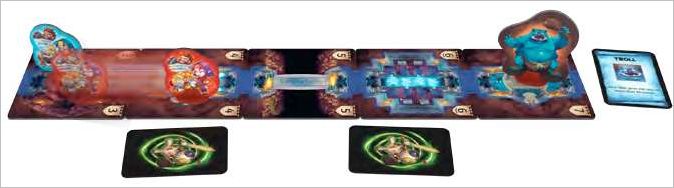
If neither team manages to guess the secret word, the monster will move one room closer to the players’ figures. But if one or both teams are successful, the monster stays put.
If the monster moves into a room with a curse, the curse will move closer to the players. If the curse comes across another curse, both curses will move closer to the players. So watch out!
And that’s how you play Trapwords! It’s a game of skill, strategy, and careful word choices. Are you up for the challenge? Gather your team, choose your trapwords, and let the guessing begin!

If neither team can guess their word in the first round, the monster will move closer. And because it moves into a cursed room, the curse also gets closer to us.
Switching Clue-Givers
After each round, we pass the torch to the next person in line to be the clue-giver. Everyone will have a turn to give clues, but if you don’t want to, you can pass the torch on.
Later Rounds
As we go deeper into the dungeon, remember these rules:
- In each round, we write down a number of trapwords equal to the room number of the opposite team. For example, if they are in room 4, we write 4 trapwords. And if we are still in room 3, they only write 3 trapwords.
- After both teams have written down their trapwords, the team that is behind gets to guess first.
If both teams are in the same room, the team that receives the book with the glowing symbol goes first. Every round, the books are exchanged, so if the teams stay evenly matched, they take turns going first.
Keep playing until one team, or both, begins the round in the same room as the monster. Remember, if neither team advances, the monster will come looking for you.
Some groups have trouble giving clues because they’re shy. If your group is struggling, you can disregard the clue-giving restrictions on page 11 until everyone feels comfortable with the game.
However, some people catch on quickly and find ways to give clues that can’t be trapped. Before this becomes a problem, introduce the restrictions on page 11.
You can adjust the timer as needed.
So here’s the deal: when we play this game, there’s a rule that says the person giving the clues should have a few seconds to look at the secret word and understand it before the timer starts. Makes sense, right? But here’s the thing – every group is different, and sometimes you gotta switch things up a bit:
If your group likes a little more pressure, you can start the timer as soon as they pick up the book. Talk about adrenaline!
On the flip side, if you’ve got players who always seem to run out of time, you can make a deal that their timer won’t start until they actually start giving clues. Gotta give ’em a fighting chance!
Curses

As you continue on in the game, you might come across a cursed room. It could happen because you moved there or because a monster forced the curse upon you. Either way, you’ll need to uncover the curse by flipping the card over.
Once revealed, the curse will only affect the very next round that takes place in that room. It introduces new rules that make the round more difficult for everyone in the cursed room.
If both teams happen to start the round in the cursed room, then the curse affects both of them. However, if one team is behind, only that team will face the curse.
After the round is over, you can discard the curse, no matter what the outcome of the round was.
When you play the game, curse cards add an extra challenge for your team in the cursed room. But don’t worry, if you’re just starting out, you can ignore the curses for now. If you’re having trouble coming up with clues, you can always save the curse cards for later when you’re more experienced.
Taking on the Monster
There are two ways you can end up in the same room as the monster:

- You can go to the monster’s room.
- Or the monster can come to your room.
When we start the round in the same room as the monster, we have a chance to win. The monster has a special rule that applies to us during that round. If both teams are in the room with the monster, the rule applies to both teams.
There are a few different outcomes. Let’s say our team is fighting the monster and the other team is behind. In that case, the other team guesses first (that’s the normal rule – the team that’s behind always guesses first). Then it’s our turn to fight the monster:

- If you can guess your word, even with the special rule from the monster, then you win the game.
- If you can’t guess your word, the game keeps going. The monster doesn’t move anymore, not even if the other team failed too. Your team stays in the room to fight the monster again.
Every monster also has a tougher version with an asterisk. You can use these in later games if you find the regular monsters too easy.
So let’s say both teams are in the same room as the monster. The team that receives the book with the glowing symbol goes first. No matter what happens, the other team also gets a chance to battle the monster.
- If both teams can guess their word, then both teams win.
- If only one team can guess their word, that team wins.
If neither of the teams can guess their word, they will need to play another round until one of them figures it out. But if your group prefers to have a single winner, here’s an alternative tiebreaker rule for you:
If both teams are fighting the monster, the winner will be the team that defeats the monster in less time. To determine the time, you can use a timer with sand. When the first team defeats the monster, tilt the timer on its side. The sand that was at the bottom will show the amount of time they used. When the second team makes their guess, this part of the timer goes on top.
The second team will have the same amount of sand as the first team used. If they manage to guess the word before time runs out, they will be the winners. But if they can’t guess it in time, the first team will be declared the winners.
Lastly, keep in mind that there is an eight-round limit to the game.
You only have 8 rounds to explore the dungeon and defeat the monster. Your trapwords sheet has 8 lists of trapwords, so when you’re writing the last list, it means it’s the final round of the game. If neither team manages to defeat the monster by the end of the eighth round, the monster wins. However, it’s more likely that one or both teams will succeed.
Now, let’s talk about what’s allowed. Your trapwords should generally be related to the word the other team is supposed to guess, and not just any random word that the clue-giver might use to describe something. Your trapwords can be nouns, like “head,” “strings,” or “animal,” adjectives, like “fuzzy,” “musical,” or “large,” or verbs, like “wear,” “playing,” or “eats.”
In Trapwords, certain rules determine which words can be used as traps. Let’s go through them step by step.
Numbers can also be trapwords, except for the number “one”. It’s important to keep this in mind.
Pronouns and helping verbs are not allowed as trapwords. This means you can’t use words like “his”, “it”, “I”, “is”, “has”, “can”, and so on.
Some words, like “one”, “thing”, “some”, “something”, “someone”, and “blank”, are also off-limits because they are too similar to pronouns. However, words like “person” or “place” are acceptable trapwords since they have many synonyms.
Since Trapwords is a game, make sure your trapwords are in line with its spirit. Avoid using words like “okay” just because you know your friend might say it. And if you write down a word like “can”, remember that it can only be triggered by clues like “It comes in a can”, not “It can be green”.
Now, let’s talk about what triggers a trap. A trap is activated when the clue-giver says a trapword or any variation of it.
Remember these rules when playing Trapwords, and you’ll have a great time!
Tips for Effective Word Guessing
Hey there! Let’s talk about some tips and tricks for guessing compound words correctly. It can be tricky, but with a little practice, you’ll get the hang of it!
- Remember that a compound word can be triggered by either part of the word. So, for example, both “base” and “ball” could trigger the word “baseball”.
- Keep an eye out for trapwords. These are words that can trigger other words when they appear in a compound word. For example, the word “light” can be triggered by “daylight”.
- Trapwords can also be triggered by closely related forms of the word. For example, the word “scientist” can trigger words like “science” and “scientific”. It can even trigger abbreviations like “sci-fi” and “SF”.
- But don’t worry too much about being super specific. For example, “conscience” and “science” may sound similar, but they’re not close enough to trigger a trap.
Counting Guesses
Now, let’s talk about counting your guesses. It’s important to be fair and reasonable when determining how many guesses you’ve made.
- Remember that some compound words count as one guess, even if they have multiple parts. For example, “hot dog” is just one guess!
- The same goes for longer phrases like “science fiction”. That’s still just one guess.
- And even if you make a really creative guess like “I’ll eat my hat if it isn’t a goblin”, that still just counts as one guess.
Statute Of Limitations
When we play the game, it’s important to be aware of traps and the rules for giving clues. Traps and rules are only triggered if we catch them within 3 seconds. If no one realizes it’s a trap, then the person giving the clue has successfully avoided the trap.
Sometimes, though, we’re not sure if something is a trap or an illegal clue. We might suspect it, but we’re not certain. This is different from not catching the clue-giver in time. In this situation, we should let the other team continue their turn. After they finish, we can talk about it and make a decision together.
What Makes a Clue Legal?
There are a few rules to make sure clues are trapable:
- We’re not allowed to use any form of the secret word as a clue. The word itself is a trapword and follows the rules for triggering traps.
Remember that when it comes to playing the game of Taboo, there are certain rules you need to follow. These rules are put in place to make the game fair and challenging for everyone involved. So, if you want to have a successful and enjoyable game, it’s important to understand and abide by these rules. Here are a few key rules you should keep in mind:
1. No specific examples: When giving clues for the secret word, you can’t use the word itself as an example. For instance, if the secret word is DOG, you can’t mention any specific type of dog. However, you can use synonyms or other words that convey the same meaning.
2. No proper nouns or proper adjectives: It’s also important to avoid using proper nouns or proper adjectives in your clues. This means you can’t mention names of people, places, or things. For example, if the secret word is MYSTERY, you can’t mention “Nancy Drew” as a clue. However, using the word “drew” as a clue for the word PEN is acceptable.
3. Clues should be about the meaning: Focus on giving clues that relate to the meaning of the word, rather than its sound or spelling. Avoid giving clues like “rhymes with” or “sounds like.” Also, refrain from revealing the first letter of the word. For instance, if the word is PAIL, don’t give clues for PALE.
By following these rules, you’ll ensure that the game remains fair and fun for everyone. So, keep these guidelines in mind the next time you’re playing Taboo and get ready for an exciting and challenging experience!
Do you like word games? I have a fun one for you! It’s called the Secret Word. The rules are simple: I give you clues for a word, and you have to guess what it is. But there’s a catch – you can’t use certain words in your clues. You can’t give clues about the spelling of the word either, only its meaning.
For example, let’s say the secret word is “DOG.” You could give clues about hot dogs, or famous dogs like Lassie, but you can’t give clues about the word “DOG” itself.
Here are some more guidelines to keep in mind:
- You can give clues for phrases that contain the secret word, as long as they are about the meaning and not just the spelling. For example, if your word is DOG, clues about hot dogs are okay, but don’t give clues about DOGMA.
- You can’t use abbreviations for proper nouns like “UK” or “FBI”. However, an abbreviation like “TV” is okay. It’s not a proper noun, even though it is normally capitalized. (Note that “TV” can be trapped with the trapword television).
- Don’t try to refer to titles by pretending they aren’t proper nouns. “I’m thinking of a game one might play with thrones”, is not a legal clue. If you want to refer to Game of Thrones, try something like, “That fantasy series where everyone dies”.
Clues
When playing the guessing game, there are some important rules that I must remember. Here they are:
- I can’t give clues that rely on personal information that the other team doesn’t know. For example, saying “That place where we used to hang out at the mall” is only allowed if people on the other team used to hang out with me.
- I can’t give clues based on objects in the room or anything that the players are experiencing in the moment.
- My clue must be based on words that can be written down. I can’t use hand gestures, my tone of voice, or a melody to give hints.
Guesses
- A guess is considered correct if it includes the secret word. For example, both “Dogs” and “hot dog” would be correct guesses for the secret word DOG.
Understanding the Challenges of Guessing Word Associations
Have you ever played the game where you try to guess a word based on clues from another person? It can be quite the mental challenge! There are a few things you need to keep in mind while playing, to make sure you’re on the right track.
- Firstly, it’s not enough to just guess a word that is somewhat related to the given clue. For example, if the clue is “SCIENCE,” guessing “scientist” or “scientific” might seem like good guesses, but they’re not close enough. Tricky, right?
- Secondly, you’re not allowed to ask the clue-giver any questions. It’s all up to you to figure it out!
- Lastly, you can’t consult with your fellow players. Once you mention a potential guess to them, that counts as your official guess.
Insights into Chosen Curses

Flood
Just breathe in your normal way while you think about your clue. Then take a really deep breath. It’s okay to give a clue, hold your breath, give another clue, hold your breath, and keep going. But once you start inhaling – even just a little bit – you can’t give any more clues.

Petrification
When a teammate guesses, you should freeze in a rigid pose, like you’ve been turned into a statue.

Echo
When we play the game Echo, I have a special role as the clue-giver. My job is to repeat every single word I hear. But here’s the thing – I don’t have to be perfect. It’s all about giving it my best shot and having some fun with it.

Feeblemind
Hey there! Let me tell you about something called Feeblemind. It’s a pretty cool word, and I’ll explain what it means. See, when someone uses the term “Feeblemind,” they’re talking about a noun. Now, a noun is a person, place, or thing. But here’s the thing – when you use the word Feeblemind, you can’t use pronouns like “I” or “it.” It’s not a rule set in stone or anything, but it’s how people often use the word. So next time you come across the word Feeblemind, remember that it’s a noun and you can’t use pronouns with it. Pretty neat, huh?

A Terrifying Word
If you stumble upon this dreaded word in the initial chamber, get rid of it immediately.

The Curse of the Mummy
Every time I face the Mummy, I get a brand new curse to deal with. It keeps things interesting, that’s for sure.
Now, when I’m up against the tougher version of the Mummy, things get even trickier. Here’s the twist – I have to deal with two curses at once! It can be a real head-scratcher, but don’t worry, I’ll explain it all.
When it comes to these combined curses, it’s important that I understand what they mean. If I’m not sure, I better double-check with everyone else playing before we kick off the round.