
Contents
Bombay Game Rules
First things first, let’s talk about Bombay, a fun and exciting game that you can play with a standard deck of playing cards. I’ll guide you through the rules and options, so don’t worry if you’re new to the game.
Objective:
The objective of Bombay is to be the player with the lowest total score at the end of the game. This is achieved by strategically selecting cards from your hand and collecting sets of cards that have the same value.
Setup:
Start by shuffling the deck and dealing 11 cards to each player. The remaining cards will be placed facedown in the center of the playing area, forming the draw pile.
Gameplay:
Once the setup is complete, the game progresses in rounds. Each round consists of two phases: the exchange phase and the scoring phase.
Exchange Phase:
During the exchange phase, players take turns exchanging cards from their hand with the ones in the center of the playing area. The goal is to improve your hand by exchanging cards that have a higher value for ones that have a lower value. The player who dealt the cards starts the exchange phase.
On their turn, a player can either pick up the top card from the draw pile or exchange one or more cards from their hand for cards in the center. When exchanging, the player must follow these rules:
– You must exchange the same number of cards as you are taking.
– You can only exchange cards of the same value.
– You cannot exchange cards that have already been exchanged during the current round.
Once a player has taken their turn, the next player in clockwise order takes their turn, and the exchange phase continues until all players have had a turn.
Scoring Phase:
Once the exchange phase is complete, the scoring phase begins. Each player counts the total value of the sets they have collected. A set is a group of cards with the same value.
In Bombay, the values of the cards are as follows:
– Ace, 2, 3, 4, 5, 6, 7, 8, 9: Face value.
– 10, Jack, Queen, King: 10 points each.
Players write down their scores and the round ends. The player with the lowest score after a predetermined number of rounds (usually 11 rounds) wins the game.
Special Rule:
There is an additional special rule called the “Bombay” rule. If a player manages to collect four cards of the same value in their hand during the exchange phase, they can reveal their set and declare a “Bombay”. In this case, the player’s score for that round is reduced to zero.
Conclusion:
Now that you know the rules of Bombay, grab a deck of cards and gather your friends for an exciting game. Remember, the key is to strategically exchange cards and collect sets with the lowest possible value. Have fun playing Bombay and may luck be on your side!


- 1 gameboard
- 1 elephant, 1 screen & 5 palaces per player
- 1 bag and 17 bales of silk
- 12 large Demand cubes
- 75 rupee tokens
- 5 Action tokens
- 8 Palace tokens
- 8 Trading Post tokens
- 16 City tokens
- 16 Client tokens
- Instructions
Let’s Get Started!
Hi there! Ready to embark on an exciting adventure? I’m here to tell you all about a thrilling game called “Bombay Bound.” In this game, you get to be a merchant, traveling around Bombay, buying and selling silk, and building magnificent palaces. The best part? The richest player wins it all! So, are you ready to dive in?
Setting the Stage
Before we begin: Let’s keep in mind that these instructions are for the 4-player game. If you’re playing with a different number of players, don’t worry! I’ll give you some adjustments on the last page to help you out.

- First, let’s set up the game. Place the board in the middle of the table. Each player will need an elephant, 5 Palace tokens, and a screen, all of the same color. Put your elephant on the starting hilltop A. The other hilltop B will remain empty.
- The player who has most recently seen an elephant will go first. This person will be the First Player and will receive 4 Action tokens. Put the 17 bales of silk (small cubes) into the bag, which should be placed near the Markets C.
- Next, we need to set up the bank. Place the rupees and the Client tokens near the board. Each player takes 2 rupees from the bank and places them behind their screen. Throughout the game, any rupees and tokens that you win will go behind your screen. You can exchange money at the bank whenever you want during the game.

In the game of Bombay, there are different cities called D. These cities have City tokens of various colors, and each city can hold three of these tokens. To set up the game, we need to follow a few steps.
For the first game, we start by placing the Palace and Trading Post tokens, as well as the Demand cubes, in specific locations shown in the picture above. But for subsequent games, we need to do some additional preparation.
First, we take the Demand cubes and arrange them in four columns. These columns are then placed randomly in the four cities.
Next, we take the eight Trading Post tokens and scatter them randomly across eight different sites, labeled E and F.
Then, we take the eight Palace tokens, which have yellow faces, and randomly place them on the eight sites marked G. The remaining sites, labeled H, are left empty.
With these steps, we can set up the game of Bombay and start playing. Good luck!
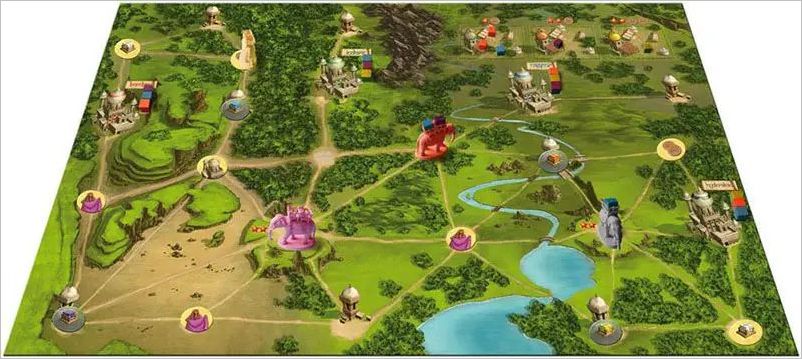
Playing the Game
When you play a game of Bombay with a group of four players, you go through four sets. Each set has a Restock phase, followed by four game turns. During each turn, you have three actions to use, starting with the first player.
The Restock Phase
As the first player, I grab the bag and take out nine silk bales. Then, I sort the bales by color and put them in the Markets:
- The most common color bales go in the left-hand Market.
- From the remaining bales, I put the most common color bales in the central Market.
- Finally, I place the remaining bale(s) in the right-hand Market.
Note: Not all markets will have every item in stock. Sometimes, certain colors may not be available for purchase. If this happens, you will have to wait until the next Restock (which is explained in the ‘Trading Post closed’ section) to buy those colors.

Let me show you how it’s done: imagine you’re playing a game. In this game, you have a bag full of brightly colored bales. Your goal is to organize these bales into three different markets. So, I start by reaching into the bag and pulling out a total of 9 bales. Three of them are yellow, three are blue, two are purple, and one is orange. Now, I have to decide where to put each bale.
I decide to put the yellow and blue bales in the left-hand Market, the purple bales in the central Market, and the orange bale in the right-hand Market. This way, each Market has its own collection of bales, creating a colorful display.
As you can see, organizing bales can be quite a fun challenge. You get to decide how to arrange them in a way that pleases you and creates an interesting visual. Plus, it’s a great way to practice your decision-making skills!

Here’s what happens: I start by choosing a combination of orange, blue, purple, and yellow bales. In this case, I decide on 3 orange bales, 2 blue bales, 2 purple bales, and 2 yellow bales. All of these bales will be put into different markets. I place the 3 orange bales in the left-hand Market, and the remaining bales – the 2 blue, 2 purple, and 2 yellow – will go in the central Market. As for the right-hand Market, it will remain empty for now.
The Trading Post is No Longer Open for Business

If, during the game, a silk bale color is not available from the Markets after a Restock or purchase, you need to turn over the 2 Trading Post tokens of that color to show that you can’t buy it until the next Restock.
Here’s how a turn in the game works: The first player puts one Action token on the board. Each player can take 3 actions on their turn. In the game, one action equals one star. Starting with the first player and going clockwise, each player uses their 3 actions.
You can choose to use less than 3 actions if you want (unused actions are discarded). You can do your actions in any order and repeat the same action twice, like moving twice. However, you can only buy one bale per turn.
The possible actions are:
A. Consolidate your Fortune.
I’m going to rewrite the given text while maintaining its meaning and structure. Here’s my revised version:
As a player, I use up all my 3 actions and collect 1 rupee from the bank.
B. Move Your Elephant
You can move your elephant from one site to an adjacent site by following a trail. The cost of movement depends on where your elephant ends up:
- If your elephant finishes on a hilltop, it will cost 2 actions.
- If your elephant finishes on another site, it will cost 1 action.
Note: It’s possible for more than one elephant to occupy the same site. Bridges, the desert, and the river won’t slow down your elephant, but it can only travel along a marked trail.
C. Buy One Silk Bale at a Trading Post (1x)
If your elephant is on an open Trading Post, you have the option to buy 1 silk bale from the Market. The color of the silk bale should match the Trading Post. To make the purchase, you need to pay the following:
- Left-hand Market: 1 rupee and 1 action for a bale.
Imagine you’re a person exploring a fascinating marketplace filled with colorful sights and sounds. As I stroll through the market, I come across two different sections: the Central Market and the Right-hand Market. Let me tell you about the unique offerings of each.
In the Central Market, you can find bales of goods at a steal of a price – just 1 rupee and 2 actions. These bales are like little parcels containing treasures waiting to be discovered.
On the other hand, at the Right-hand Market, the bales come with a slightly higher price tag of 2 rupees and 2 actions. They may be a bit pricier, but they still hold the potential for great finds.
Now, here’s the catch – once you buy a bale, you have to transport it on an elephant. Each elephant can only carry a maximum of 2 bales, so you can’t buy more if your elephant’s basket is already full.
Remember, when you’re exploring these markets, you can only make one purchase per turn. So choose wisely and make the most out of your time and resources.
I hope you have a delightful time exploring the markets, discovering hidden treasures, and adding some excitement to your journey!

Example: I move my elephant from the top of the hill to a purple Trading Post. It only takes 1 action.
This action is very important in the game. It’s called a ‘move’ and it allows you to change the position of your game piece on the board. In my case, I’m moving my elephant to a Trading Post, which is a special space on the board. The color of the Trading Post is purple.
Moving your game piece to a Trading Post can be a strategic move because it can give you certain advantages in the game. For example, it might allow you to collect resources or gain special abilities. But you have to be careful because other players can also try to move their game pieces to the same Trading Post and compete with you for those advantages. It’s like a race to see who can reach the Trading Post first and claim its benefits.
To make a move in the game, you have to spend a certain number of actions. In my case, it only takes 1 action to make this move. Actions are a limited resource in the game, so you have to think carefully about how you use them. You don’t want to waste actions on moves that don’t give you any strategic advantages. It’s important to plan your moves carefully and consider all your options.
In conclusion, this move to the Trading Post is a crucial action in the game. It’s a strategic decision that can give you certain advantages, but you have to be mindful of other players trying to do the same. By making smart moves and using your actions wisely, you can improve your chances of winning the game. So think strategically and make your moves count!

So, I just bought this purple bale, you know? I got it from the Market, which cost me 1 rupee and 2 actions. That means I used up all my 3 actions, and now it’s the next player’s turn.
Oh, and check this out! I can sell one silk bale in a city!
If my elephant is in a city, I can spend 1 action to sell one silk bale. But here’s the catch: the color of the silk bale has to match one of the 3 Demands of that city.
Selling Silk Bales
- If the color of the bale is on top, I earn 4 rupees.
- If it’s in the middle, I get 3 rupees.
- If it’s at the bottom, I only get 1 rupee, but I also get 1 Client token.
Oh, and here’s a bonus: some colors of bales are worth more than others:
- A yellow bale earns me an extra rupee.
- A purple bale gives me an extra Client token.
Demands of the City
So, here’s what happens after you make a sale: the city’s Demands change. Specifically, the Demand cube that has the same color as the bale you sold is moved to the bottom of the scale. Meanwhile, the other bale or bales move up one place on the scale. But wait, there’s a twist! If the cube you sold was the same color as the one at the bottom of the scale, the Demands of the city stay the same.
Hey, listen up: Let’s say you sell not just one, but two bales (by using two actions in a row to make those sales). In that case, the city’s Demands (and yeah, the sale price too) will change after each sale.
City Token

Why Do We Need Sleep?
Sleep is a fascinating phenomenon that remains full of mysteries. It is something we all experience and yet don’t fully understand. So why is sleep so important?
First and foremost, sleep is essential for our bodies to rest and repair. When I sleep, my body has the opportunity to regenerate and recover from the day’s activities. It’s like pressing a reset button for the next day. Without enough sleep, I would feel tired, irritable, and less focused.
But sleep is not just about physical restoration. It also plays a crucial role in our mental well-being. It helps me process and consolidate information, making it easier for me to remember things and learn new skills. Have you ever noticed how you feel more forgetful and less able to concentrate after a sleepless night? That’s because sleep deprivation affects our cognitive function.
Moreover, sleep is important for our overall health. It helps keep our immune system strong, protecting us from illnesses. Lack of sleep can weaken our immune system, leaving us more vulnerable to infections and diseases.
Getting quality sleep is essential for my emotional and mental well-being too. It helps regulate my mood and emotions, making me feel more balanced and able to cope with stress. On the other hand, a lack of sleep can increase feelings of anxiety and irritability.
So how can I ensure a good night’s sleep? Well, creating healthy sleep habits can make a significant difference. I can start by creating a comfortable sleep environment, free from distractions and noise. Developing a relaxing bedtime routine and avoiding screens before bed can also help signal to my body that it’s time to sleep.
In conclusion, I now understand the importance of sleep for my overall well-being. It not only allows my body to rest and regenerate, but it also plays a vital role in my mental, emotional, and physical health. By prioritizing sleep and practicing good sleep habits, I can ensure that I am at my best every day.

Here’s what I do when I want to shake things up in Bombay: I make some changes. Brown, that’s me, moves the purple Demand cube to the bottom of the scale. Then, I take the orange Demand cube, which used to be at the bottom, and move it up one place. But that’s not all. I also grab a City token from Bombay, because I don’t have one yet.
E. Build One Palace
If my elephant happens to be on a site with no buildings on it – no Trading Post, city, or palace – I can build a palace. All I need is 1 action and 1 silk bale of any color from my elephant. The silk bale goes back into the bag, by the way. Once I have everything I need, I can place one of my palaces on the site. Oh, and if there’s already a Palace token on the site, I get to take it and use its special effects. Pretty neat, huh? (Check out ‘Palace tokens’ for more info on those.)
Let’s talk about the interesting things that happen when you have a palace in the game. It’s pretty cool, actually! When one of your opponents goes to a place where you have a palace, you get 1 rupee from the bank. It’s like a little bonus for having a palace there. And at the end of the game, your palaces also earn you some rupees. So it’s a good investment!
Just so you know, if you go to one of your own palaces, you don’t get any extra rupees. It only works when someone else visits your palace. But hey, it’s still a nice perk, right?

Example: Imagine a place where I can create my very own palace. All I need to do is take one action and use one silk bale, and voila! My palace is built.
Palace Tokens
 I put the token behind my screen. When the game ends, this token gives me an extra Client token.
  I hide the token behind my screen. At the end of the game, it counts as an extra City token.
  I return the token to the game box and get two rupees from the bank.
My Turn Ends, Your Turn Begins!
I place my token back in the game box and select a silk bale in my favorite color from the Market, choosing the one farthest to the left. Then, I place the bale onto my elephant.
Once all players have taken their turn, the game turn comes to an end. If I, as the first player, still have Action tokens remaining, a new turn starts just like before. I place an Action token next to the board, and each player, starting with me and moving clockwise, spends 3 actions.
But what if I, as the first player, run out of Action tokens? Well, that means the set is over.
When a new set starts, the player on the left side of the previous first player becomes the new first player. This player takes the 4 Action tokens and the game continues.
I collect all the bales from the Markets and put them back in the bag. I flip the Trading Post tokens so that ‘Open’ is facing up.
A new set starts (Restock + 4 game turns). Once each player has been the first player once (after four sets), the game ends.
End of the Game
Players earn their reward:
– Palaces and Clients
– City Tokens
The player with the most money (including money earned throughout the game) wins.
If there’s a tie, the winner is the player with the most Client tokens among those who are tied.
Bombay with 2, 3, and 5 Players
For 2 players, the game consists of 4 sets. Each set includes a Restock, followed by 4 game turns.
I’m going to explain how the game works. It’s pretty cool, so pay attention!
- Each game consists of multiple sets.
- In each set, the first player changes.
- The first player gets to use 4 Action tokens. These are important for marking each set.
- There are some tokens you need to know about. City tokens are placed next to each city. Trading Post tokens come in 4 different colors and are placed randomly around the E sites. Palace tokens are distributed randomly on the G sites, yellow side facing up.
- At the end of the game, the player with the most Palaces + Clients gets 4 rupees. The other player gets nothing.
Now let’s talk about playing with 3 people.
In a 3-player game, there are 3 sets. In each set, there is one Restock and 5 game turns. Each player will have a chance to be the first player once. The first player uses 5 Action tokens to mark the sets.
- A stack of 2 City tokens is put beside each city.
- Only 4 Trading Post tokens are used (one of each color). They are put randomly around the E sites.
- Palace tokens are randomly distributed, with the yellow side facing up, on the G sites.
- At the end of the game, the player who has the most Palace + Clients tokens receives 6 rupees, while the second player gets 2 rupees.
The player in last place receives nothing.
5 Players
A game consists of 5 sets. Each set contains one Restock and 3 game turns.
During the game, I will be the first player once. I will use 3 Action tokens to mark the sets. Also:
- If I start the game in the fifth position, I will receive 3 rupees instead of 2.
- A stack of 4 City tokens is placed beside each city.
As I explore the wonderful world of game mechanics, I stumble upon a fascinating concept called “Palace tokens” – those mysterious game elements that have captivated many players. These tokens, with their vibrant yellow color, are sprinkled randomly on the G sites. This randomness adds an element of surprise and anticipation to the game, keeping us on our toes, wondering where the next Palace token will land.
Now, let’s fast forward to the end of the game, where the tension is at its peak. It’s time to unveil the grand winner, the player who has amassed the highest total of Palaces + Clients. This skilled individual is rewarded handsomely with 8 rupees. The second-place contestant, not to be overshadowed, receives a respectable prize of 6 rupees. The third-place finisher is likewise acknowledged with 4 rupees, leaving the fourth-place competitor with a modest but still appreciated reward of 2 rupees. Alas, the brave soul who finds themselves in last place walks away empty-handed, yearning for another chance at victory.
But that’s not all! We mustn’t forget the City tokens, which play a significant role in the game as well. Unlike the Palace tokens, the money earned from City tokens remains constant, regardless of the number of players. This adds an interesting twist to the game, as it creates a level playing field for all participants.
So, as I delve deeper into the intricacies of this captivating game, I am reminded of the thrill and excitement that awaits me. With each game, a new adventure unfolds, filled with unpredictable turns and the chance to emerge as a triumphant champion. Join me on this journey, and let’s uncover the mysteries of Palace tokens together!