
Contents
- 1 Welcome to the World of Terra Mystica!
- 1.1 Setting Up the Game
- 1.2 Commanding Your Faction
- 1.3 The Importance of Cults
- 1.4 Victory and Beyond
- 1.5 Now let’s set up the game!
- 1.6 Here’s what we’re aiming for:
- 1.7 Phase II. Actions
- 1.7.1 1. Change and Construct
- 1.7.2 2. Advancing on the Shipping track
- 1.7.3 3. Lowering the Exchange Rate for Spades
- 1.7.4 4. Upgrading a Structure
- 1.7.5 5. Assign a Priest to a Cult
- 1.7.6 6. Power actions
- 1.7.7 7. Special actions
- 1.7.8 8. Passing and becoming the new Starting player
- 1.7.9 9. Starting a Town
- 1.8 Phase III Cult Bonuses and Clean-Up Phase
Welcome to the World of Terra Mystica!
Hey there! Are you ready to embark on a thrilling journey into the magical realm of Terra Mystica? Great! I’m here to guide you through the game rules and help you become a master of this enchanting world. So, let’s dive in and discover the wonders that await!
Setting Up the Game
First things first, let’s get everything ready for our adventure. You’ll need the game board, which represents the mystical land of Terra Mystica, and each player will have their own Faction board, representing a unique magical faction. Choose your Faction wisely, as each one has its own special abilities and strengths.
Next, set up the game board by placing the different terrain tiles on their designated spaces. These tiles represent the diverse landscapes of Terra Mystica, such as forests, mountains, and rivers. Each terrain type has its own advantages and restrictions, so be strategic in your placements.
Commanding Your Faction
Now that everything is prepared, it’s time to start playing! As the leader of your chosen Faction, it’s up to you to transform the land and expand your power. The goal is to earn the most Victory Points by building structures, terraforming the land, and interacting with other Factions.
On your turn, you’ll have a number of important actions to consider. You can upgrade your Faction, which unlocks new abilities and bonuses. You can also build different structures, like dwellings, temples, and strongholds, that will enhance your Faction’s power and influence.
But be careful! Each action you take consumes Power, a valuable resource in Terra Mystica. You’ll need to manage your Power wisely to ensure you can continue taking actions and grow your Faction’s strength.
The Importance of Cults
Another key aspect of the game is the interaction with the four Cult tracks: Earth, Fire, Water, and Air. By gaining the favor of these Cults, you’ll earn additional Victory Points and unlock special bonuses. However, each Faction has an affinity for specific Cults, so choose wisely which ones to focus on.
Each round, the players will allocate Power to the Cult tracks, competing for the highest influence. The Cults will reward the top players, so it’s crucial to stay ahead in this competition to secure victory.
Victory and Beyond
The game continues until the round tracker reaches the last space, signaling the end. At this point, players will count their Victory Points, earned through various actions and achievements. The player with the most Victory Points emerges as the grand champion of Terra Mystica.
And don’t fret if you don’t win the first time around! Terra Mystica is a game of deep strategy and planning. With each play, you’ll learn more about your Faction, discover new tactics, and improve your skills. So, don’t be discouraged – embrace the challenge and let the magic of Terra Mystica enchant you!
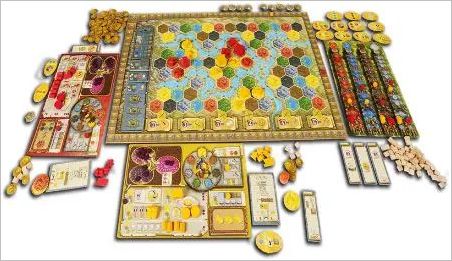
- Includes 1 Game board and 1 Cult board
- Comes with 7 Faction boards
- Consists of 56 Terrain tiles
- Includes 65 natural-colored Workers
- Comes with 40 small Coins, 25 medium coins, and 20 big coins
- Includes 65 purple Power tokens
- Comes with 7 x 8 Dwellings
- Includes 7 x 4 trading houses
- Comes with 7 x 1 stronghold
- Includes 7 x 3 temples
- Comes with 7 x 1 sanctuary
- Includes 7 x 7 priests
- Comes with 7 x 7 Markers
- Includes 7 x 3 bridges
- Comes with 1 orange Starting player token
- Includes 17 Action tokens and 1 Game end token
- Comes with 5 “100 Victory points” tokens
- Includes 28 oval Favor tiles
- Comes with 10 Town tiles
- Includes 9 Bonus cards
- Comes with 8 rectangular Scoring tiles
- Includes 5 “Actions” Overview tiles
- Comes with 12 zip-lock bags
Now let’s set up the game!
Here’s what we’re aiming for:
At the end of the game, whoever has the most Victory Points wins. Victory Points are represented by brown squares with laurel wreaths.
Check out this tutorial video to get started!
During each of the six rounds, we go through three phases:
1. Income Phase: Collect new Workers, Coins, Priests, and Power.
2. Action Phase: Take actions to build and expand your civilization.
3. Cult bonuses and Clean-up Phase: Receive bonuses for meeting certain goals and tidy up the game board.
Let’s dive deeper into Phase I: Income.
In this phase, you gather resources such as Workers, Coins, Priests, and Power.
During the first round, you collect your faction-specific starting income, and then you also collect income for that round.
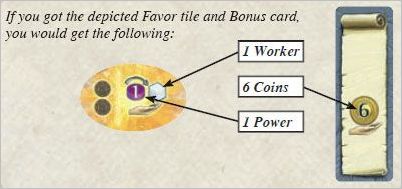
Your income is determined by the Structures you’ve built, the Bonus card you’ve chosen, and, later in the game, the Favor tiles you own. You can recognize income symbols by an open hand.
Lastly, let’s talk about the basic income you receive for your Structures.
Workers: So, here’s the deal. When it comes to the game, one of the key things you need to know is workers. They play a crucial role in your success. You’re probably wondering why, right? Well, let me break it down for you.
See, workers are like the backbone of your operation. They’re the ones who get things done, making sure everything runs smoothly. And let’s face it, without them, you’d be in big trouble.
Now, let me explain how it works. You start with a certain number of workers, based on the symbols on your Dwelling track. The more visible symbols you have, the more workers you get. It’s a pretty simple concept, really.
But here’s the thing. You need to be strategic about how you use your workers. It’s not just about the quantity, it’s about the quality too. You need to assign them to the right tasks, so you can maximize their impact.
Think about it like this. If you have a bunch of workers, but they’re all assigned to the wrong jobs, then you’re not going to get much done. It’s all about finding that balance and making sure each worker is in the right place.
So, when you’re playing the game, keep this in mind. Workers are your secret weapon. They’re the ones who make things happen. And if you want to come out on top, you need to take full advantage of their power.

Coins: When I’m at my Trading house track, I grab some Coins from the general supply. I make sure to take as many Coins as there are Coin symbols visible on my track. It’s a way for me to stock up on those valuable Coins.
Priests: If I’ve developed my Temple track, I can take Priests from my own supply. I’ll take as many Priests as there are Priest symbols visible on my track. Once I’ve built my Sanctuary, I’ll even have one more visible Priest symbol. It’s all about increasing my religious influence.
The Swarmlings’ Sanctuary and the Darklings’ Sanctuary are particularly special because they provide a bonus of 2 Priests. That’s even better!
After I gather my Workers, Coins, and Priests, I place them on my Faction board. Here’s the thing, though: if I run out of Workers or Coins, I’ll have to replace them with something else. Luckily, there’s no limit on the number of Priests I can have. They’re always a valuable resource.
Power: I gain power by looking at the fancy symbols on the Trading House track. The Stronghold usually gives me even more power, but some factions have different tricks up their sleeve. For example, the Alchemists get extra coins, the Chaos Magicians get more workers, and the Fakirs get an extra priest.
Extra stuff
In addition to the income I get from my Faction board, I also get some bonuses from my Bonus card. It’s like getting a little something extra on top of everything else!
The Mighty Bowls of Power
Hey there! Did you know that I have these awesome Bowls of Power that hold the key to unleashing incredible abilities? Let me tell you all about it!
So, I have 12 Power tokens, and I like to distribute them into three magical Bowls. Now, here’s the thing – in order to perform these amazing Power actions, I need to have Power in Bowl III (that’s the one on the right, by the way).
Imagine the possibilities! With Power in Bowl III, I can tap into its energy and use it to make glorious things happen. It’s like having a secret superpower that only certain individuals possess!
But here’s the deal – I have to be strategic about how I distribute my Power tokens. Sure, I want to make use of the Power in Bowl III, but I also have to make sure I have enough Power in the other Bowls. It’s a delicate balance, my friend.
When I have the right amount of Power in each Bowl, I can execute my moves with precision and make the most out of every situation. It’s all about finding that sweet spot and making those Bowls overflow with magnificent Power!
Just remember, my friend, that in this world of Power and magic, the Bowls hold the secret to greatness. Keep an eye on Bowl III, the true source of Power, and watch as you tap into its might and achieve extraordinary feats!
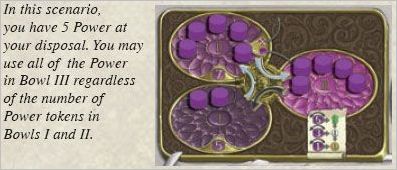
When you earn Power in the game, whether it’s through income, when an opponent builds Structures, or by advancing on the Cult tracks, you won’t receive new Power tokens. Instead, you’ll be moving the ones you already have from one Bowl to another. And when you use Power for a Power action, you won’t lose any Power tokens either – you’ll just be moving them around.
Here are the rules for moving Power tokens:
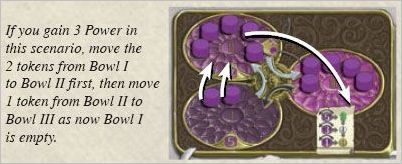
When I want to gain Power, I follow these steps:
- If there are Power tokens in Bowl I, I move one token from Bowl I to Bowl II for every 1 Power I gain.
- Once Bowl I is empty, I move one token from Bowl II to Bowl III for every 1 Power I gain.
- When all Power tokens are in Bowl III, I can’t gain any more Power.
I can only use Power tokens that are in Bowl III. I move them to Bowl I when I spend them.
Phase II. Actions
During the Action phase, I start with the Starting player and then go in a clockwise order. Each player takes one Action until no one wants to take any more Actions.
I have eight options for Actions. I can choose to do any of them multiple times during the same Action phase, except for passing, which I can only do once per turn.
1. Change and Construct
First, you can alter the type of one area of land. And if you change it to match your Home terrain, you can right away build a Dwelling on that spot.
Constructing a Dwelling
To construct a Dwelling on a land area, the following conditions must be met:
- The spot must be in your color (meaning it must be your Home terrain).
- No one else can be occupying it.
- The spot must be directly or indirectly adjacent to one of your Structures. (We’ll explain what “adjacent” means in the next section).
You also have to pay the costs to build. One Dwelling requires 1 Worker and 2 Coins. (Please note: The Engineers only need 1 Worker and 1 Coin to build Dwellings, while the Swarmlings require 2 Workers and 3 Coins).
Changing a land area
When it comes to building a Dwelling, it’s important to choose the right spot. You want to find a Terrain space that suits your needs. But how do you go about finding the perfect location? Well, one strategy is to transform an unoccupied Terrain space into your Home terrain. This gives you more control over the placement of your Dwelling.
Here’s how it works: before building your Dwelling, you can select one empty Terrain space and make it your Home terrain. You simply place a Terrain tile of your color on that space. This allows you to create a personalized area that fits your strategy and gameplay style.
By having your Home terrain, you have a dedicated space that you can use to your advantage. It gives you a sense of ownership and helps you establish a strong presence on the map. Plus, it allows you to adapt to the ever-changing needs of the game. Need more control over a specific area? No problem! Simply build your Dwelling on your Home terrain, and you’re good to go.
Choosing the right location for your Dwelling is a crucial decision in the game. It can greatly impact your strategy and overall success. So, take the time to assess the available options and consider transforming an unoccupied Terrain space into your Home terrain. It’s a simple yet effective way to elevate your gameplay and increase your chances of victory.
Remember, the key to success is finding the perfect spot for your Dwelling. And by making a Terrain space your Home terrain, you can create a personalized area that suits your needs and enhances your gameplay.
Transformation comes at a cost. Every time I move between different terrain types on my Faction board’s Transformation cycle, I have to spend 1 Spade. This means that if I want to transform adjacent terrain types into each other, it will cost me 1 Spade. However, if the terrain types are on opposite sides of the cycle, the cost can go up to 3 Spades because I can move in either direction on the cycle.
There is an exception for Giants, though. They always have to pay exactly 2 Spades to transform any type of terrain into their Home terrain.
I can acquire Spades in different ways. One way is by exchanging Workers for Spades. The Exchange track on my Faction board shows me the exchange rate. Usually, at the start of the game, I can exchange 3 Workers for 1 Spade (this is shown in Action #3).
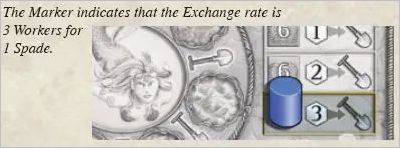
Hey there! Did you know that you can get 1 or 2 Spades by performing certain Power actions? Plus, there’s even a Bonus card that gives you 1 Spade!
Oh, and here’s something cool: Halflings and Giants can get extra Spades right after they build their Stronghold. Pretty handy, right?
Now, normally, you can only use Spades to transform one Terrain space. But, there are a couple of exceptions you should know about:
- If the Spades you get from a Power action or a Bonus card aren’t enough to transform a Terrain space into your Home terrain, you can exchange some Workers for the extra Spades you need. Just keep in mind that the Exchange rate depends on your Exchange track.
- When you gain 2 Spades and you only need one to turn a Terrain space into your Home terrain, you can use the second Spade on another Terrain space. Pretty neat, huh? But, just a heads up, you can’t build a Dwelling on that second space. (This also applies to the Halflings when they build their Stronghold and get 3 Spades right away. Check out the last page for more info).
Building Your Dwellings
When I’m building, I need to choose Structures (including Dwellings) from my Faction board, starting from the left and moving to the right. If the current Scoring tile shows a Dwelling, I earn 2 Victory points for each Dwelling I construct. This Scoring tile rewards me with 2 Victory points for building Dwellings.
Using Your Spades
Remember, I can’t save my Spades for later. I have to use them right away.
If the left side of the current Scoring tile shows a Spade, I earn Victory points for utilizing Spades during the current Action phase. This Scoring tile grants me 2 Victory points for using Spades.
When I transform a Terrain space, I’m not required to immediately construct a Dwelling. I can choose to do so during a future Action at a later time.
When you’re trying to settle in a new area, you have the option of transforming the terrain to make it your home. However, keep in mind that this is not always possible because of the cost involved. Instead, you can stop at a different type of terrain if you can’t afford to transform it further.
It’s important to note that even if you choose not to build a dwelling on the transformed terrain, your opponents may still claim it during their turns. As long as there are no structures on the terrain, it is considered unoccupied and up for grabs.
Regardless of whether you decide to build a dwelling or not, the transformed terrain must be adjacent to one of your existing structures. This means it needs to be directly or indirectly connected to your settlement.
Keep in mind that you cannot transform a terrain space that already contains structures. This includes any existing buildings that may be in the area.
If you’re looking for additional spades to aid in the transformation process, you can also earn them through cult bonuses. However, it’s important to note that you cannot immediately use these spades to build a dwelling. You have to wait until the next action phase to do so, and you cannot exchange workers for more spades.
Understanding Adjacency
So, here’s the deal: when it comes to building Dwellings, there’s a few things we need to keep in mind. One of those things is the difference between direct and indirect adjacency of Terrain spaces. It might sound a little confusing, but don’t worry, I’ll explain it in simple terms.
Direct adjacency
Direct adjacency basically means that Terrain spaces and Structures are right next to each other, sharing a hexagon edge. It’s like when two friends are standing side by side, they’re directly adjacent. Easy enough, right? But there’s a twist. Terrain spaces and Structures can also be considered directly adjacent if they’re separated by a River, but connected with a Bridge. It’s kind of like a secret passageway between two places – they might not be right next to each other, but they’re still connected.

The Sneaky Connections
When it comes to connecting different terrain spaces and structures, there’s a concept called indirect adjacency that you need to understand. It may sound complicated, but it’s actually quite simple.
Imagine you have two terrain spaces or structures that are not directly next to each other. Instead, they are separated by one or more river spaces. Now, if your shipping value is high enough, you can still consider these two locations as indirectly adjacent.
Speaking of shipping, it’s another action that we’ll discuss later. But just keep in mind that it plays a key role when it comes to creating these sneaky connections.
But that’s not all. Dwarves have their own special way of reaching places through tunneling, and Fakirs can use carpet flight to their advantage. When they utilize these abilities, they can also consider terrain spaces and structures as indirectly adjacent to one another.
So you see, even if things may seem far apart or disconnected at first, there are always hidden ways to make the connections you need. It’s like finding secret paths in a maze!
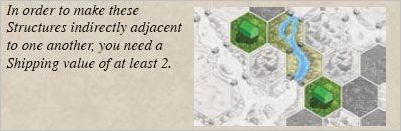
Note: When I build Dwellings, my opponents have the opportunity to gain Power. I will explain this in Action #4 “Upgrading a Structure”. But before that, let’s take a look at two other Actions that will help me build Dwellings throughout the game: advancing on the Shipping track and lowering the Exchange rate for Spades.
2. Advancing on the Shipping track
If I want to expand beyond River spaces, my Terrain spaces and Structures need to be indirectly adjacent to each other.
To transform Terrain spaces or build Structures beyond River spaces, I can move the Marker on my Shipping track forward by one space. The costs for this Action are displayed on my Faction board: 1 Priest and 4 Coins.
As a reward for taking this Action, I will receive a number of Victory points based on the Shipping space that I move to.
3. Lowering the Exchange Rate for Spades
When the game starts, Spades are priced at 3 Workers each (see Action #1). But you have the power to bring that cost down to 2 Workers or even 1 Worker. How? By taking the following action: move the Marker on your Exchange track up by one space. Your Faction board tells you what you need to pay for this action: 2 Workers, 5 Coins, and 1 Priest.
There are exceptions, though. Halflings have to pay fewer Coins for this action. And Darklings don’t even have an Exchange track; instead, they use Priests to exchange for Spades.
As a reward for making this move, you earn 6 Victory points.
4. Upgrading a Structure
You can gradually upgrade your Structures. The costs for each upgrade are shown on your Faction board, to the left of the Structure.
Always start by upgrading the leftmost Structure on your Faction board.
When you upgrade, you’re basically swapping out one structure for another. All you have to do is take the structure you want to upgrade off the game board and put it back on your faction board. This will decrease your income from that type of structure. Just make sure to put the returned structure all the way to the right on its track. Then, you can place the new upgraded structure right where the old one was on the game board. And if you’re building a trading house, you’ll need to return a dwelling to your faction board.
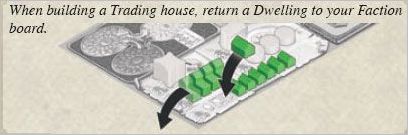
When playing the game, you have the opportunity to make four different upgrades, although two of them can only be done once.
If you want to upgrade a Dwelling to a Trading house, it will cost you 2 Workers and 6 Coins. However, if there is an opponent’s Structure right next to your Dwelling, you can save some Coins and only pay 3 instead of 6. Plus, if the current Scoring tile shows a Trading house, you’ll earn 3 Victory points for this upgrade.
On the other hand, if you decide to upgrade a Trading house to a Stronghold, the costs will vary depending on your faction. Each faction has its own specific special ability that you gain after building a Stronghold.
And if the current Scoring tile shows a Stronghold, you’ll receive an even greater reward of 5 Victory points for this upgrade.
When you upgrade a Trading house to a Temple, it costs you 2 Workers and 5 Coins. The good news is, you get to choose a Favor tile as a reward! And not only that, you get to use it right away. The Favor tile will give you some advantages during the Action phase. Just make sure not to pick a tile you already have.
If you want to take your Temple to the next level and turn it into a Sanctuary, the cost will vary depending on your faction. It will require Workers and Coins. But don’t worry, you’ll be rewarded with another Favor tile. And if the Scoring tile shows a Sanctuary, you’ll even get 5 Victory points for making this upgrade.
Now, let’s talk a bit more about the rewards you receive when an opponent builds a Structure.
The Power of Structures
Every Structure comes with its own Power value. You can find this value on the right side of the Faction board, next to the structure’s track.
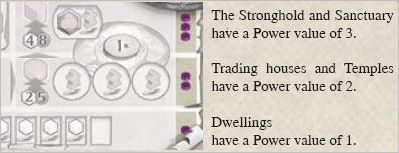
When I build a house or upgrade a building, I have to let the neighbors know that they might benefit from it too.
To know how much power my neighbors can gain, I add up the power values of their buildings that are right next to my new building.
I don’t get any power from my own buildings. Power only comes when my neighbors build something.
Starting with the player on the left of the active player and going around clockwise, each neighbor has to decide if they want to gain power or not. The next part explains why someone might choose not to gain power.
The cost of power
Unfortunately, gaining Power through Structures comes at a cost. To acquire that Power, you must sacrifice Victory points, with the number of points lost being one less than the amount of Power gained.
So, if you gain 1/2/3/4/� Power, you will have to give up 0/1/2/3/� Victory points.
However, it’s important to note that your Victory point total cannot go into negative numbers.
Also, you cannot choose to gain less Power in order to save Victory points. It’s an all-or-nothing situation. The only exceptions are if you don’t have enough Power tokens in Bowls I and II, in which case you can gain enough Power to move all tokens to Bowl III and lose Victory points accordingly. Additionally, if gaining Power would result in a negative score, you can gain just enough Power to bring your Victory point total to 0.
Keep in mind that you only lose Victory points when gaining Power through Structures. If you gain Power through other means, you won’t lose any Victory points.
- When my opponent builds Structures, I gain Power. This can give me an advantage over my opponent.
- I can also gain Power from my Trading houses and Stronghold. This provides me with a steady income of Power.
- There are also two specific Bonus cards that can give me Power as income.
- I can gain Power from two specific Favor tiles as well.
- When I found a Town and take the specific Town tile, I receive a one-time reward of Power. Founding a Town can be a strategic move.
- In Phase III of the game, if the specific Scoring tile is up for the current round, I can earn a one-time Cult bonus of Power.
- I also gain Power when I advance on the Cult tracks. This allows me to increase my influence and power in the game.
I’ll tell you about the different ways I can gain Power in the game. Power is an important resource that allows me to take various actions and advance in the game. Here are the different ways I can gain Power:
In addition to these methods, there are other ways to gain Power in the game. Power is a valuable resource that I need to carefully manage and utilize in order to succeed. By understanding how to gain Power, I can make strategic decisions and optimize my gameplay.
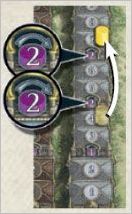
When you progress on the Cult tracks of Earth, Water, Fire, and Air, you can gain power. You’ll receive 1/2/2/3 Power respectively for reaching the 3rd/5th/7th/10th spaces on a Cult track. Remember, this Power is only granted once when you reach or pass these spaces.
If you’re playing as the Nomad (yellow) and advance these 3 spaces on the Cult of Air track, you’ll gain 4 Power. However, keep in mind that only one player can reach space 10 on each Cult track. To do so, you must also have established a Town for each space 10 you wish to advance to. For more information on founding a Town, please refer to page 14.
5. Assign a Priest to a Cult
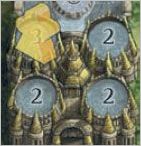
There’s a special place for each of the Earth, Water, Fire, and Air Cults. It’s called a track, and it can hold one Priest. If you want, you can take one of your Priests and place them on a Cult’s track. This will let you move forward 3 or 2 spaces on that Cult’s track.
Moving forward on a track can also give you Power. You can learn more about how to gain Power by moving on a Cult’s track in the section above.
Once you place a Priest on a track, you can’t get them back. Remember, you only have 7 Priests to use.
If you don’t want to lose a Priest, you can return them to your supply next to your Faction board. But if you do that, you’ll only be able to move forward 1 space on the Cult’s track.
6. Power actions
Power actions come in two types: fully-fledged Actions and auxiliary Actions.
Power actions on the Game board
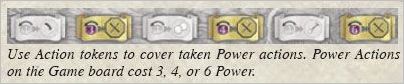
Hey there! Let’s talk about the powerful actions you can take on the game board. You’ll notice these actions marked by orange octagons, and they are pretty special. But here’s the deal – you can only do each one once per round. It’s first come, first served.
Now, when you decide to take one of these actions, it’s going to cost you some Power tokens. You’ll need to move a number of tokens from Bowl III to Bowl I, and the number is the same as the cost indicated. After that, you’ll place an Action token on the game board to show that no one else can use that action this round. It’s all yours!
Sacrificing Power
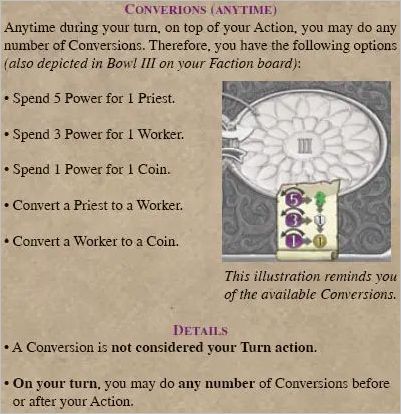
If you don’t have enough Power in Bowl III to do a specific Power or Conversion action, you can transfer Power tokens from Bowl II to Bowl III and take the desired Action. However, for each Power token you move this way, you have to remove 1 Power token from Bowl II permanently. This means you’ll have fewer Power tokens in your cycle going forward. (Note: This is not possible if you only have 1 Power token in Bowl II).
7. Special actions
You can only take each Special action once per round.
Special actions are marked by orange octagons and can be acquired in various ways.
Some factions gain a Special action when they construct their Stronghold.
In the game, there are Favor tiles and Bonus cards that offer special actions to help me move forward on the Cult track. With one Bonus card, I can even transform a Terrain space by getting a free Spade.
I can use Action tokens to show which special actions I have already taken.
8. Passing and becoming the new Starting player
If I don’t want to take any more actions or if I can’t take any more actions, then I have to pass. Once I pass, I can’t take any more actions for the rest of this round.
The first player to pass becomes the Starting player in the next round. They also get the Starting player token.
When I pass, I have to return my Bonus card and take one of the three available Bonus cards. It could be a card that another player has already returned this round.
But there is one exception: In the last round of the game (round 6), I don’t take any more Bonus cards. And if there were Coins on the Bonus card I took, I put them on my Faction board.
If you return specific Bonus cards, you can earn Victory points.
When you pass and return the Bonus card on the right, you get 1 Victory point for every Dwelling you have on the Game board. When you pass and return the Bonus card on the left, you get 2 Victory points for every Trading house you have on the Game board.
If you pass and return the Bonus card on the right, you get 4 Victory points if your Stronghold is already built and/or 4 Victory points if your Sanctuary is already built.
Remember to collect these Victory points. Pay attention to the current Scoring tile: you may earn Victory points for constructing certain Structures, using Spades, or founding Towns.
Hey there! You have the freedom to choose any of the three Bonus cards available. Just pick the one you like best. Remember, you can’t immediately take back the card you just returned.
If you want, you can place the new Bonus card face-down in front of you to show that you’ve already passed.
There’s no limit to how many resources you can keep for the next round. So feel free to hold onto as many as you want.
You can take as many Actions as you want, even if everyone else has already passed. As long as there’s at least one person still taking Actions, the current Action phase will keep going.
9. Starting a Town
At some point in the game, you might found one or more Towns. Towns are automatically founded when two conditions are met:
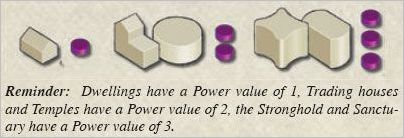
- If four structures of the same color are next to each other, it’s a Town. Only three structures are needed if one of them is a Sanctuary.
- The total Power of the structures in the Town must be at least 7.
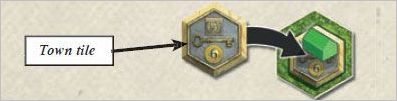
Once you’ve met these criteria, you can found a Town by selecting a Town tile and placing it beneath one of the structures in the Town.
The Perks of Establishing a Town
Hey there! Did you know that founding a Town in this game comes with some awesome benefits? Let me break it down for you:
When you decide to build a Town, you immediately score a bunch of Victory points. The number of points you get depends on the Town tile you choose. Plus, if the current Scoring tile shows a key, you’ll earn even more Victory points! How cool is that?
But that’s not all! Once you found a Town, you also get to enjoy the rewards depicted on the Town tile you picked. These rewards can be really useful. You can either boost your progress on all the Cult tracks by moving up one space on each track, or you can get one Priest, two Workers, six Coins, or eight Power. It’s like getting a little treasure trove all to yourself!
And here’s an exciting twist: every Town you found comes with a key. Now, why are these keys special? Well, they allow you to go all the way to the very last space (space 10) on any of the Cult tracks. Without a key, you’d have to stop at space 9. So, having those keys can make a huge difference in your strategy!
Now, let’s talk about how Towns are formed. When you found a Town, any Structures that are directly adjacent to each other become part of that Town. Bridges are especially important here because they help connect those Structures. It doesn’t matter if you have more Structures than the minimum required – as long as they’re next to each other, they’re part of the Town.
Oh, and did I mention that indirect adjacency doesn’t count when it comes to founding a Town? That means you don’t have to worry about structures being connected through River spaces. The only exception is the Mermaids – they can ignore one River space when founding a Town. Pretty handy, right?
When you build new structures right next to an existing town, that town expands instead of creating a whole new one.
If you combine two existing towns to form a larger town, those towns don’t lose their own rights or functions, even though it may be hard to tell where their borders are.
You can only have a maximum of 10 towns in one game.
Phase III Cult Bonuses and Clean-Up Phase
Once all players have passed (see Action #8 on the left), the current action phase comes to an end. In rounds 1 to 5, the action phase is followed by a clean-up phase that prepares for the next round.
There is no clean-up phase after the last round.
Cult Bonuses
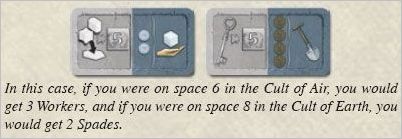
First, I need to make sure to give out the Cult bonuses shown on the Scoring tile. If you’ve made enough progress in the Cults shown, you’ll get the rewards multiple times if necessary.
We award the Cult bonuses in the order that we’ll play the next round. This is important for the Spades.
When you receive Spades as a Cult bonus, you can’t get any additional ones. The Fakirs can’t do a Carpet Flight, and the Dwarves can’t do Tunneling when receiving Spades as a Cult bonus. This is because both Carpet Flight and Tunneling have costs that can only be paid during the Action phase. Also, if the Giants only get one Spade as a Cult bonus, they have to give it up.
You can’t save Spades for future turns. You can use them on different adjacent Terrain spaces.
In Phase III, you can’t build a Dwelling.
Now it’s time to return our Action tokens.
If there are any Action tokens on Power action spaces on the Game board, Special action spaces on Faction boards, or Favor tiles and Bonus cards, you should remove them from there.
Now, let’s talk about the Coins on Bonus cards. We need to put 1 Coin from the general supply on each of the three leftover Bonus cards. If a card hasn’t been taken by any player for two rounds, it will now have 2 Coins on it.
Lastly, it’s important to turn the Scoring tile face-down as the last act of the current round. This way, only the Scoring tiles of the following rounds will remain face-up.
Now, let’s get into the end of the game.
When the game reaches its end, everyone has finished taking their turns in the final round’s Action phase. Once this happens, it’s time for the final scoring. You won’t get any Cult bonuses during this last round, as shown by the Game end token.
Cult scoring
Let’s calculate the scores for each of the four Cult tracks individually:
- The player at the top of a track gets 8 Victory points.
- The player in second place on a track gets 4 Victory points.
- The player in third place on a track gets 2 Victory points.
You can see these values in the top left corner of the Game board. If you’re still on space 0, you won’t earn any Victory points. In case of a tie, divide the Victory points among the tied players equally (rounding down if needed).
Area scoring
Hey there! Let’s talk about determining the number of structures that are next to each other. It’s pretty important because it can earn you some Victory points.
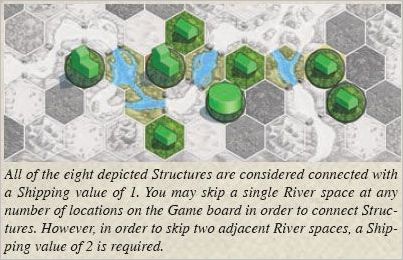
First, you need to figure out how many of your structures are directly or indirectly adjacent to one another. Keep in mind that even scattered areas can indirectly connect if you use the right shipping value.
The player who has the most connected structures gets a big 18 Victory points. If you’re second in line, you’ll still get a decent 12 Victory points. And if you’re third, you’ll score 6 Victory points.
By the way, you’ll see these values displayed in the top left corner of the game board. In case there’s a tie, don’t worry – just split the Victory points evenly among the players who are tied. Round down if necessary.
Now, let’s talk about resource scoring.
Here’s a neat trick to get even more Victory points: convert your leftover resources into Coins. You’ll earn 1 Victory point for every 3 Coins you have. That means all those other resources can come in handy too!
If you’re playing as the Alchemists, you’ll earn 1 Victory point for every 2 Coins you have. It’s a simple way to boost your chances of winning!
So, who wins?
The player with the most Victory points takes home the victory. If there’s a tie, then you can have multiple winners. It’s all about coming out on top!